|

Ernst
von Dohnányi
around 1949 photographed in New York (edited picture taken from a
Remington cover).
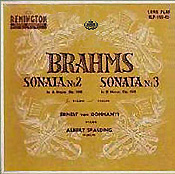
The
Violin Sonatas Nos. 2 and 3 of Johannes Brahms played by Albert Spalding
and accompanied by Ernst von Dohnányi
on an early Remington..

Violin
Sonata No. 1 played by the same artists.


|
In
1894 Ernst von Dohnányi went to Budapest to study with Hans
Kössler (composition), with István Thomán (piano), and
for a short time with famous composer and pianist Eugen d'Albert.
Koessler later also taught Béla Bartók. Both d'Albert and Koessler
were admirers of Johannes Brahms and on top of that d'Albert had been
a pupil of Franz Liszt. Each certainly played a role in the education
of young Ernö, either by influencing the development of the talent
of the young pianist and composer, or most likely by reaffirming Dohnányi's
affinity with the classical form which made him a great interpreter
of Beethoven in his time.
Ernst
von Dohnányi (Ernö Dohnányi) was born on
July 27, 1877 in Pozsony (=Bratislava), then a Hungarian city close
to the border with Austria. His father was not only an amateur cellist
but also a physics professor who certainly loved the classics and
had a feeling for form and structure more than he was interested in
free music making and new ways of expression. This is not without
significance because his father gave him the first lessons before
he became a pupil of Karl Förstner, the organist of the Pozsony Cathedral.
|
|
|
Pozsony
(Bratislava) is the birthplace of Ernst von Dohnányi. Zoltán
Kodály (born in Kecskemét) lived for several years
in Galanta. And Béla Bartók was born in Nagyszentmiklós
which is now called Sînnicolau Mare and is in Romania (on
the map not far from Timisoara). Bratislava and Galanta are nowadays
on Slovak territory.
Hungary as part of the Austro-Hungarian Empire,
and Hungary before WW II - Map (c)1995, drawn by R.A.B.
|
After
his graduation in 1897 - his Symphony in F was rewarded the King's
Prize - Dohnányi made his debut in Berlin. Two years later
his (First) Piano Concerto won the Bösendorfer Flügel
Preis (also known as Von Bülow Preis) given by the famous
Viennese piano manufacturer to the best student. Dohnányi dedicated
his concerto to his teacher Eugen d'Albert.
 Second prize winner
of the competition was Jan Willem Frans Brandts-Buys (1868-1939) from
the Netherlands with his Concerto in F. Third was Eduard Behm (1862-1946)
from Germany. The final round of the competition was on March 26,
1899.
Second prize winner
of the competition was Jan Willem Frans Brandts-Buys (1868-1939) from
the Netherlands with his Concerto in F. Third was Eduard Behm (1862-1946)
from Germany. The final round of the competition was on March 26,
1899.
Dohnányi
toured Europe and the United States until 1908.
After being a piano teacher in Berlin at the "Hochschule für
Musik" until 1915, he returned to Budapest and at the age of
42 was appointed associate director of the National Hungarian Royal
Liszt Ferenc Academy (Franz Liszt Academy).
Between
1921 and 1927 he again toured Europe and the USA where he was appointed
chief conductor of the New York State Symphony Orchestra and that
is where, in 1921, young Edward Kilenyi was presented to him.
Dohnányi
performed in London and was a guest conductor of the (Royal) Concertgebouw
Orchestra, Amsterdam. At
the same time he continued teaching piano. Pianist  Edward
Kilenyi and conductor
Laszlo
Halasz (who started off as a pianist) were amongst his pupils
in the nineteen twenties, and both are representatives of the Hungarian
school. Dohnanyi was instrumental in the education of György
Cziffra. Other pupils were Ervin Nyiregyházi and
Ernö
Szegedi. Even
Béla
Bartók studied with Dohnányi for a short time.
Edward
Kilenyi and conductor
Laszlo
Halasz (who started off as a pianist) were amongst his pupils
in the nineteen twenties, and both are representatives of the Hungarian
school. Dohnanyi was instrumental in the education of György
Cziffra. Other pupils were Ervin Nyiregyházi and
Ernö
Szegedi. Even
Béla
Bartók studied with Dohnányi for a short time.
|
|
|
Young
Ernst von Dohnányi
Picture taken from the
cover of the recording of Ernst von Dohnányi's Piano Concerto
No. 1 performed by pianist Balint Vaszonyi and conductor John
Pritchard (PYE LP TPLS 13052).
|
To
the outside world this all seemed to be a glamorous career. But in
fact Dohnányi's life knew turbulence and animosity. His biography
tells us that his career was hampered because he refused to work under
the dictatorial regime of Miklos Horthy (1921-1939). Although he had
criticized Horty's links with fascism, he himself was accused of collaborating
with the German occupants during World War II from 1944 until April
4th 1945. A severe blow was that his son Hans (father of conductor
Christoph von Dohnányi) was executed because he was involved
in the coup against Hitler in 1944, plotted by Claus von Stauffenberg
and his group.
In that same year, 1944, Ernst von Dohnányi quit his post of
conductor of the Budapest Philharmonic Orchestra (which he held since
1919).
|
|
|
A
pre World War II recording of Ernst von Dohnányi conducting
the Budapest Philharmonic Orchestra in Franz Liszt's Hungarian
Rhapsody No. 1 (the orchestral version of No. 14) on Columbia
9550/1 (listed as such in The Gramophone Shop Encyclopedia of
Recorded Music, Simon and Shuster, New York 1942).
|
In
1931 he had become music director of the Hungarian State Radio and
in 1934 had been appointed director of the Budapest Conservatory (Franz
Liszt Academy), a post which he officially held until 1948.
|
|
|
After
Christoph von Dohnányi (born in Berlin in 1929) had won
the "Richard Strauss Prize for Conducting and Composition"
in 1951, he went to study with his grandfather Ernst von Dohnányi
in Tallahassee, Florida.
Image Deutsche Grammophon Gesellschaft.
|
But
by that time he had left Hungary, running from his personal enemies
and fleeing for the communists who aligned Hungary to the Soviet Union.
Dohnányi went to live in Buenos Aires, Argentina, where he
stayed only for a short time. On the instigation of conductor Laszlo
Halasz and pianist Edward Kilenyi the then seventy two
year old maestro applied for the post of professor at the Florida
School of Music, Tallahassee. He started teaching there in 1949 and
four years later (1953) he was joined by his pupil Edward Kilenyi.
Amongst Dohnányi's pupils in Florida was his grandson Christoph
von Dohnányi who received his formation as a conductor.
In
1955 Ernst von Dohnányi became a US citizen. During his stay
in New York in 1960, where he recorded his Second Piano Concerto
for Bob Whyte's Everest label, Ernst von Dohnányi died,
on February 9.
In
his time Ernö Dohnányi was a great interpreter of Beethoven, Brahms,
Schubert and Liszt. As a composer his style was influenced by Brahms
and Liszt and did not develop into a modern idiom (contrary to the
styles of Bela Bartók, and to a certain extend the idioms of Zoltán
Kodály and Leo Weiner). Dohnányi's style is romantic, somewhat less
Hungarian, but above all very personal.
His
best known composition is his Opus 25 from 1914: Variations on
a Nursery Song for Piano and Orchestra, which has been recorded
by the big record labels and the famous pianists the world over.
His
Violin Concerto No. 1, Op. 27, from 1914 (also stemming from
his most prolific period of the early nineteen hundreds), is less
comprehensive, and more rhapsodic. It is not a virtuoso piece for
the sake of virtuosity. There are influences of Brahms, Bruch and
Mendelssohn-Bartholdy, yet it is truly Dohnányi's.
The
concerto had to wait until 1986 to receive its first recording. The
performance of this four movement concerto by violinist Gottfried
Schneider and the Bamberger Symphoniker (Bamberg Symphony) conducted
by Yoel Levi was released on the Schwann label, as a CD and
as LP (Schwann VMS 2112). It is a sensitive performance of this music
evoking drama and passion.
Dohnányi's
Piano Concerto No. 1 in E Minor from 1899 had to wait until
1972 to be premiered on LP on the PYE label from Great Britain, reference
TPLS 13052. The passionate concerto written in a flamboyant style
was very well performed by Bálint
Vaszonyi,
excellent Brahms interpreter, who came to Florida in 1958 to study
with Dohnányi. In fact he was Dohnány's last pupil.
|
|
|
Ernst
von Dohnányi and his pupil Edward Kilenyi around 1955.
Together they had made a recording for Columbia playing on two
pianos 'Suite en valse' coupled with Kilenyi playing 'Waltz Settings',
on a 12 inch Columbia Long Play disc (ML-54256).
Copyrighted photo courtesy of The Ernst
von Dohnányi Collection at The Florida State University.
|
Edward
Kilenyi was Recording Director of Remington Records, Inc. until 1953,
the year he took up the post of teacher at the Florida School of Music.
Then Laszlo Halasz became Recording Director of Don Gabor's label.
The contacts of Ernst von Dohnányi with Edward Kilenyi, and
with his fellow countrymen Donald Gabor and Laszlo Halasz, resulted
in several recordings for the Remington label.
Although Dohnányi's performances have to be judged in view of his
age, it is regrettable that Don Gabor did not make better sound recordings,
especially when 'Dohnányi plays Dohnányi' (Four Rhapsodies)
and Schumann's 'Scenes from Childhood' (Kinderszenen). It would have
been welcomed if more takes had been recorded. However the original
tapes of the recordings show much intensity. That is especially the
case in the performance with Albert Spalding of his Violin Sonata
Op.21.
Ernst
von Dohnányi's Remington recordings:
R-199-16
- Beethoven: Piano Sonata No. 17 and Andante Favori in F Major.
Haydn: Variations in F Minor
C.G.
Burke made an comprehensive study of the recordings of works
by Beethoven which was published in High Fidelity Magazine,
Spring 1952 edition. He explained how the study was made.
"There are 230 recorded versions of 119 Beethoven works, occupying
329 sides (...) this compendium reviews every Beethoven work
recorded on LP as of mid-January. (...) Since the synopsis was
conceived as a practical guide for music lovers, the writer
has submerged his own prejudices as rigidly as he could. He
has tried to indicate the broader, the more universal values
of the discs, rather than certain niceties or certan eccentricities
pleasing or repellent to himself."
About
Beethoven's Piano Sonata No. 17 Burke wrote:
"Two
versions have patent merit with that of Mme. Novaes somewhat
preferable in the sound of her piano (although the recording
is good average in both cases), and especially because of an
episodic delicacy very rewarding in the simple outlines in the
candid and open-hearted Sonata. The Dohnanyi has some superirority
of dynamics without the gentleness of Mme. Novaes's poetry."
- C.G. Burke - High Fidelity, Spring 1953
Ernö Dohnany was about 74 when he recorded this Sonata
for the Remington label and Guiomar Novaes 18 years younger.
|
|
Click
here for a Sound Clip of a fragment of the Third
Movement of Beethoven's Sonata No. 17 performed by Ernö
Dohnanyi.
|
|
|
R-199-43
- Dohnányi: Four Rhapsodies Op. 11, Schumann: Kinderszenen
(Scenes from Childhood), announced by Ernst von Dohnányi himself.
The interest of this recording is the fact that the composer plays
his own Op. 11, but regrettably at a rather late age, and therefore
not always in a controlled manner, which can also be said of the rendition
of the Beethoven Sonata.
R-199-49
- Brahms: Sonatas Nos. 2 and 3 for Violin and Piano - Albert Spalding,
violin, with Ernst von Dohnányi, piano; released in 1951.
R-199-84
- Brahms: Sonata No. 1 ("Regen") Op. 78 Albert Spalding, violin,
with Ernö Dohnányi, piano - coupled with Hungarian Dances
Nos. 8,9 and 17, with Anthony Kooiker at the piano.
This record was released in the spring of 1952. The liner notes, written
by Edward Tatnall Canby, suggest that these performances with Spalding
were recorded in the fall of 1949 when Dohnányi came to New
York when visiting the United States, before he took up the post of
professor at the Florida School of Music.
Dohnányi: Sonata for Violin and Piano, Op. 21 (written
in 1912 in Berlin) was recorded in 1952 with violinist
Albert
Spalding and Ernst von Dohnányi at the piano, but was
never released on Remington records. Tom Null issued this performance
for the first time on Varèse-Sarabande VC 81048 in 1978
- coupled with Enesco's Violin Sonata No. 2 played by George Enesco
himself and
Céliny Chailley-Richez
at the piano. See
The Remington Series.
Researched and written by Rudolf A. Bruil. Page published
in the Fall of 2002.
To honor the 125th anniversary of Dohnányi's birth and to commemorate
the ten years he spent as a teacher at the Florida State University,
an International Ernst von Dohnányi Festival was held from
31 January through 2 February 2002. Many guest artists who attended
and performed were conductor Matthias Bamert, pianist Barry Snyder,
cellist János Starker, musicologist and leading Dohnanyi scholar
Alan Walker, pianist and Dohnanyi researcher Deborah Kiszely-Papp,
and pianist Bálint Vázsonyi. - R.A.B.
|


