

|
 PREVIOUS
PAGE
/ This is
Page 3 of 5 Pages /
NEXT PAGE
PREVIOUS
PAGE
/ This is
Page 3 of 5 Pages /
NEXT PAGE
Names and short texts in bold colored font on these pages are links to
separate pages and profiles of artists and other persons.
Names in bold font may appear as a link later in the text.
|
Owner and producer
of Remington Records, Being of Hungarian descent is an important fact. It explains why so many artists, who had fled Hungary and other Eastern European countries, just before World War II, or had come to the US right after World War II had ended, were asked by Don Gabor to record for his labels at some time or other. If they had not been born in Europe, their parents would have and naturally had strong ties with the homeland. Or they simply had studied in Europe. That
is why names like Pianist
|
 |
 |
Donald
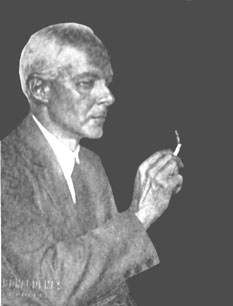
Gabor (at left) recorded Béla Bartók in his home in New
York in 1941. Conductor Laszlo Halasz at right.
|
 |
|
|
|
 |
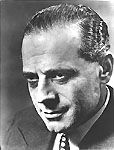
Marcel
Prawy in the early nineteen seventies when he compiled a series of LPs
with opera highlights for Deutsche Grammophon.Picture taken from DGG LP
2532 001. Photo credit: Will Appelt, Wien.
|
 |
|
Don
Gabor knew singers Martha Eggerth and Jan Kiepura, the famous
operetta couple. Martha Eggert was from Hungary. (Note: in various publications
her name is also spelled as Marta Eggerth and as Marta Eggert.) The couple
had left Europe in 1939 and went to live and perform in the USA. In 1940
Martha Eggerth sang in the Broadway musical 'Higher and Higher'. They
played in the Broadway production of the operetta 'The Merry Widow' in
the 1943-1944 season. Their recordings became available on Columbia. When
the LP format was introduced they appeared on Continental record CLP 2012
which indicates that Gabor must have made a few recordings with them already
in the 78 RPM era as these recordings were dubbings from 78 RPM acetates. Through
this contact Gabor had met Austrian |
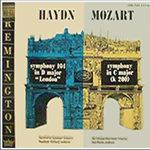 |
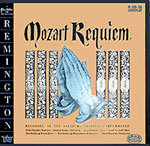
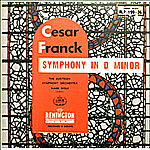
Haydn
and Mozart by Paul Walter. Mozart's Requiem by Josef Messner, a Salzburger
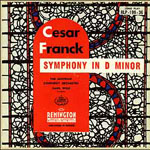
Festspiele recording and Hans Wolf conducts Symphony in D by Franck.
|
 |
 |
|
Donald
Gabor had started with ethnic music but he put himself on the map as a
producer when he started Continental Records. There is already
mention of Gabor and his Continental Company in 1942 when he was accused
of not complying with the regulations during World War Two. And he is
already listed in Billboard's Music Year Book of 1943. It is not sure
if he received a loan from his former RCA boss Tetos Demetriades
to set up his business. But there were certainly businessmen who wanted
to invest in a new and growing business of a young entrepreneur. Demetriades
made himself an independent record producer of recordings with ethnic
music. During
the war years Donald Gabor contemplated to start the Remington Records
label (named after the Remington Phonograph Corporation which went bankrupt
in 1921, but probably also because of the widespread use of the name for
different brands: Remington typewriters, Remington pianos, and of course
Remington is the manufacturer of guns and rifles). He planned to release
a vast catalog of classical music. The execution of his plan was hastened
after the 33 1/3 Long Playing record had been introduced in 1948 by Columbia. Gabor asked Marcel Prawy in Vienna to hire artists and make arrangements for recordings. Vienna was and is "the music capital of Europe". Producer Marcel Prawy (who later became chief dramatist at the "Wiener Oper" - Viennese Opera - wrote books, introduced the American musical in Vienna, and became a popular TV personality) arranged for the recordings with well known conductors who had earned national recognition through their work with the Austrian Radio Broadcasting Corporation (Österreichische Rundfunk, ORF) while performing in concerts and operatic productions of which Vienna always has a lot to offer. These
conductors were Kurt Wöss, Wilhelm Loibner (1909-1971),
Gustav Koslik (1902-1989), Felix Prohaska , Paul Walter, Max Schönherr
(1903-1984; who conducted highlights from Die Fledermaus on R-199-41),
Astrid Varnay (1918-2006) and Rosette
Anday (1903-1977) were recorded, and there are even performances with
Irmgard Seefried, Hilde Zadek, Anton Dermota (1910-1989), Lorenz
Fehenberger, Ferdinand Franz, and with conductor
Josef Messner (1893-1969), while
at the same time American conductor
H. Arthur Brown traveled to Vienna to
conduct the Niederöstereichisches Tonkünstlerorchester. Also pianist
Edward Kilenyi Jr. recorded in Vienna (with Felix Prohaska). |
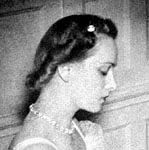 |
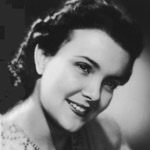
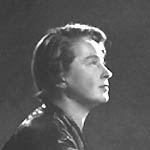
Sari
Biro and Felicitas Karrer,
|
 |
|
 |
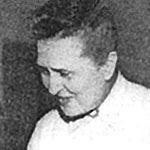
Frieda
Valenzi and Céliny Chailley-Richez.
|
|
|
Prawy also approached the younger generation of performers who just had left the 'Musikhochschule' or the "Viennese State Academy for Music and Dramatic Art" and were starting a career. Pianist Alexander Jenner told me that Mr. Prawy would ask a young musician to study, say, Beethoven's 'Diabelli Variations' and be ready in two weeks time for a recording session. The
sessions arranged by Prawy produced material to be released not only on
Remington but in several cases also on the Plymouth/Merit label on which
artists like pianists Marcel Prawy produced the recordings from 1950 till the end of 1952 and actually owned the rights. Some of these recordings with the same artists were released on European labels in the nineteen fifties and later in the nineteen sixties and seventies and not only contained the performances of Austrian artists but also recordings with the Italian conductors Erasmo Ghiglia, Alberto Poeletti, Luigi Ricci, and Vittorio Gui. (A page with opera recordings is in the making). The
recordings of |
|
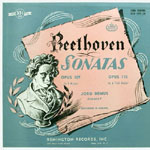
Jörg Demus plays Beethoven: Piano Sonatas Nos. 30 (Op. 109) and 31
(Op. 110) on R-199-29
|
 |
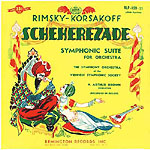 |
An
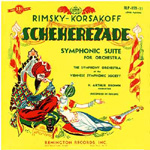
American in Vienna: Rimsky-Korsakov's Scheherazade conducted by H. Arthur
Brown on R-199-11
|
|
And
when American artists traveling in Europe came to perform in Vienna, recordings
were made either by the Austrian Broadcasting Organization or produced
by
Marcel Prawy. Examples are recordings by pianist Sari Biro, pianist Edward
Kilenyi and of mezzo-soprano At the same time recordings were made at home in the USA. Examples are some of Kilenyi's solo recordings and the performances of Ernst von Dohnányi with Albert Spalding which were recorded as early as the fall of 1949, although mention of a contract with Spalding is first announced in 1950 after he had recorded the three Brahms Violin Sonatas. And many titles which were released on Continental records, were gradually re-released as Remington discs. Don Gabor had been working in the shipping department of RCA Victor. His job with RCA is quite significant for his approach. Initially he was not employed in the production offices or the studios, but just saw the many carton boxes, filled with shellac records, which had to be sent to the various dealers. That is where he probably got the idea that the quantity could be increased if the records were less expensive. And if he himself was going to start a label to be distributed on a large scale, it only would be feasible if he kept the price low in order to achieve a large enough turnover. At that time the record industry was not a highly thriving business economically. So Gabor had ideas of his own, just as Eli Oberstein had, who was by ten years Gabor's senior. If Oberstein had some influence seems logical. Oberstein had also been working at Victor and had started on his own, two years before Don Gabor did. Donald Gabor was also aware of the way unknown artists were treated before they were profitable to the company and acquired star status. Victor was known for the meager fees the artists would be paid. And he himself had to deal with artists when producing records when he had become head of Victor's foreign record department. One
other very important fact was that Gabor knew many artists who had left
Europe and still remained in the USA. New York was full of them. He certainly
had met quite a few of them. So there were possibilities when, as a young
man of just thirty, he left RCA in order to establish his own business.
An early address which was mentioned was on Broadway, but in Billboard's
Music Year Book of 1943 263, West 54th Street, is the address of
the company of which Donald H. Gabor is president and Mrs. Donald H.
Gabor is vice-president. (Interesting note is that Gene Krupa and
Cozy Cole founded the In the 1980's and 1990's Ye Olde Tripple Inn was located at the former address of Don Gabor. A few years ago Streetview showed that the low buildings and houses had been torn down and that section of 54th Street became a construction site. Old Google Maps showed that much of the work had been done and office buildings had been erected. But the New Google Maps also shows old Street view images which do not represent the state the street is in now, in 2015. |
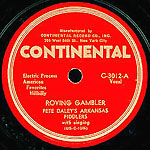 |
Don
Gabor's first label was Continental in the 78 RPM era. Broadway is the
company's address, soon to be changed to 263 West 54th St. which
later housed Ye Olde Tripple Inn, a famous New York dive bar.
|
 |
 |
|
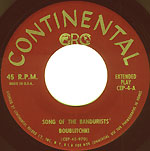
Gabor's
first recordings were done when he was still employed by RCA. Gabor had
special labels with ethnic music like the Csardas
Label for the "Hungarian" market, and the White Eagle label
for the "Polish" market. Record covers of 78 RPM records from the W.W.II
era list the different labels of the company. The first Csardas recordings
date back to November 25, 1940 as David Diehl told me. Famous artists
were Frank Yankovic and Victor Zembruski. Victor Zembruski (the Connecticut
Polish Orchestra), recorded later for the Continental Record Company and
his recordings were released on both the White Eagle and Continental labels
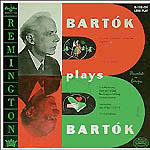
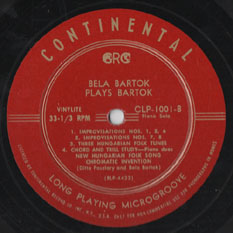
and were later re-released on Remington, Paris, Palace, and Masterseal. On Continental Gabor released popular music, jazz and also some classical music. "The Gramophone Shop Encyclopedia of Recorded Music" (New York, 1948) mentions the existence of the label as indicated by CON, but the recordings are few and are not easily detected in the lists, except for Continental C 4005 on which Béla Bartók plays Slow Melody, Walachian Dance, Whirling Dance, Quasi Pizzicato, and Ukrainian Song of the Bag Pipe Players. Another fellow-Hungarian who recorded for Don Gabor was Andor Foldes who fled Europe and had come to America in 1940. On Continental 78 RPM with reference CON 22 (which is also referred to as C5033) he plays March from 'The Love of The Three Oranges' (Prokofiev) and Polka from the ballet 'The Golden Age' (Shostakovich). On Continental 78 RPM (CON 34) he plays Albeniz: Seguidillas (No. 5 from Cantos de Espana), Sevillana (from Suite Espanola). On Remington RLP-149-4 (33 RPM) he plays Mazurka (Chopin), Prelude (Chopin), Three Waltzes from Op.39 (Brahms), Lullaby (Brahms), The Maiden with the Flaxen Hair (Debussy), Valse oublié (Liszt), Prelude in B Flat (Gershwin), Dance fantastique (Shostakovich) Spanish Dances Nos. 5 and 6 (Granados). Foldes is actually better known for accompanying violinist Joseph Szigeti on Columbia 78 RPM (Debussy, Hubay, Kodaly, Schubert), his recordings made in Denmark for the Tono label after the war playing Beethoven Sonatas, piano music by Schumann (which also appeared on Mercury Records), and for the many recordings he made for Deutsche Grammophon Gesellschaft: Mikrokosmos (Bartók), Rachmaninoff (2nd Piano Concerto), Modern repertory (Barber, Copland, Stravinsky) and music of Beethoven and Mozart. |
 |
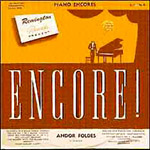 |
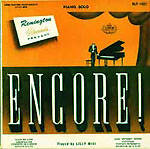
Andor Foldes
plays 'Encore', as does Lily Miki on another album originally recorded
on Continental 78 RPM discs.
|
 |
|
There
are also sets of Continental 78 RPM records with harpsichordist Dorothy
Lane in a complete edition of Bach's Well Tempered Clavier
(according to Irving Kolodin to be preferred over Isabelle Nef's l'Oiseau
Lyre recordings, at least sound wise). The
Continental label was later also an LP-label with various releases of
classical and popular music: The
most famous Continental releases are those of Most of Gabor's 78s were pressed at the Scranton Record Mfg. plant which at the time was the largest independent plant in the US. Even after Capitol bought the plant in 1946, records were pressed there, because Eli Oberstein, another remarkable figure in the history of recorded sound in the nineteen forties and fifties, continued to have access to the Capitol plant. Oberstein controlled most of the shellac which was in very short supply at the time. In 1948 Oberstein took over the bankrupt Sonora Co. and in 1949 he regained his New Jersey Plastics Co. and started to press LPs from then on. Another
important name in early American LP history is Webster Manufacturing
Co. of Webster, Massachusetts. Webster - as the story is told - had
once been a center of textile manufacturing, but just after World War
II, the Webster Manufacturing Co. had moved to a nonunion site in the
South (which was a not uncommon practice for companies to avoid regulations),
leaving behind an empty factory and an unemployed labor force. That is
where Don Gabor and his Continental Record Company come into focus. Gabor
persuaded the workers to help him buy the factory and install record-pressing
equipment to produce 78 RPM discs for him. Gabor decided that from 1949
on the plant would only press plastic 45 rpm and 33 rpm disks. See |
 |
 |
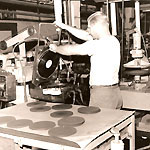 |
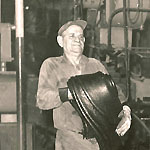
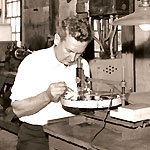
The Webster Pressing
Plant: production of the cheap vinyl mix (vinylite), matrix quality control,
and record pressing
|
|
The
major attraction of tape was, of course, that longer recording sessions
were possible and above all splicing was feasible, thus a performance
without (too many) errors could be compiled. There was however another
important advantage. Tape made it possible to add a second playback head
a few inches before the actual playback head. The signal picked up by
this playback head steered the cutter head When a dynamic passage was
picked up by this second head it was possible to allow more land between
adjacent grooves which contained high dynamics. (In Europe this method
was even further developed by Decca and Telefunken which had formed the
TELDEC company in Germany. The system was called "Füllschrift" because
of the possibility to economically use the unused land separating the
groove during less loud passages.) The
Mercury engineers were the first to use this system in the US and named
it "margin control". They did apply it also manually to give
optimum room for the groove when the signal contained high dynamics (loud
passages in the music). The best example is the Mercury recording of Tchaikovsky's
"1812 Overture" (first in mono and later a new recording was done in stereo).
On Remington records no sign of margin control can be detected. Margin
control was an attribute of quality and would have been a luxury for a
label like Remington. So the recordings were certainly not mastered by
Mercury in Chicago, which was also a new and independent label at the
time. And Mercury had their classical records pressed at RCA Victor's
and jazz and pop at their own plant. It
is not certain if Eli Oberstein pressed a number of releases for Gabor.
Many Plymouth pressings (of the second label) have the look and feel of
Oberstein's What really is quite certain: the quality of the plastic was definitely not of the same standard as the vinyl used by the big companies. Gabor used a cheap substitute for his discs which were not entirely free from surface noise - to put it mildly. And there is a difference between the quality and flexibility of the early vinylite substitutes and the later compounds he used. Differences can also be noted in the quality used for the various labels. Especially in the beginning the plastic was hard and not flexible at all, and even brittle and grainy, and the discs were not unbreakable. A demonstration of its flexibility often resulted in a cracked or broken disc. |
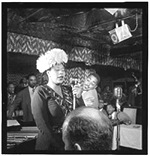 |
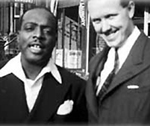
Ella Fitzgerald and Slam Stewart. (Copyright: William P. Gottlieb) and
Count Basie with Timmie Rosencrantz (courtesy Sepia Jazz).
|
 |
 |
|
Don
Gabor was a well known figure in the New York music and manufacturing
scenes and knew how to persuade people to work with him and/or have their
recordings released on his labels. He knew violinist Enoch Light
(who was a trained classical musician) and his band "The Light Brigade".
Light recorded for RCA and Columbia, and also made recordings with Don
Gabor at the end of the nineteen forties on 78 RPM. On Continental C 1175:
Laughing on the outside, Got a date with a disc (Enoch Light and his Orchestra
and Loren Becker). These recordings were later released on the Remington
label in the 7" Don
Gabor also made recordings in the nineteen forties with young jazz artists,
who stood at the beginning of their careers, and released them on his
Continental 78 RPM label: Dizzy Gillespie, Slam Stewart, Ethel Waters,
Dorothy Donegan, Cozy Cole, J.C. Heard, Edmond Hall, Hot Lips Page, Eddie
South and Timmie Rosencrantz. There were releases in the 1000, 10000, 3000, 6000 and 8000 series. It is impossible to compile complete listings of the releases, but for the lover of jazz and for the collector I list a few. It is remarkable to not only find Sarah Vaughan, Dizzy Gillespie and Slam Stewart, but also Louis Armstrong and even Leonard Feather, who started off as a musician and later concentrated on writing and publishing, among other things his Encyclopedia of Jazz. These discs were released with and without a preceding "C". An "S" means "stamper". |
 |
 |
 |
|
Naturally
these recordings were later released on LP on the Remington label and
are quite unique. Some of the recordings of Sarah Vaughan from 1944 and
1945 can be found on Remington RLP-1024, and later on R 199-258, on Masterseal
MS 55, Palace A 673 and in the nineteen fifties and sixties on other labels
of Gabor. The same goes for the 78 RPM Continentals of Slam Stewart and
Ethel Waters. A
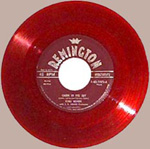
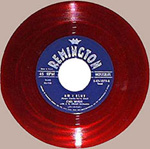
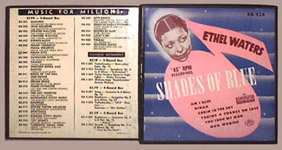
very nice presentation was the boxed set of three 45 RPM discs of Ethel
Waters with the title "Shades of Blue". The titles: Am I Blue
(with a blue label), Dinah, Cabin in the Sky, Taking a Chance on Love,
You Took My Man and Man Wanted. The Copyright is 1951 and the reference
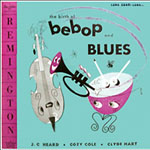
number is RB-924. On Remington R-1033 Eddie South, Slam Stewart, Red Norvo, Johnny Guarneri, Morey Field and Wayne Chuck perform Talking Back, Bell for Norvo, Voice of the turtle, Slamming the gate, Twelve o'clock at night, Eddie's blues and Singing the blues. The heading on the cover reads "Modern American Musicians". Remington RLP 1035 features orchestral music conducted by Edmund Hall, Timmie Rosencrantz and "Hot Lips" Page. The cover of Remington R-1032 reads "Cafe society swing" by the Timmie Rosencrantz, Cozy Cole and Sabby Lewis orchestras. All these recordings were re-released in the nineteen fifties and sixties on Masterseal, Palace, Buckingham, etc. |
 |

|
 |
 |
|
Don
Gabor often recorded groups and people that were probably only known locally.
He issued many recordings in the popular sector for all sorts of nationalities
with Polish, Hungarian, Russian, Slovene, Spanish and Portuguese artists.
Portuguese fados sung by young Amalia Rodriguez were released on
Continental. (Even Frank Chacksfield appears on the label). Another
example of the ethnic releases is RLP-1010 of The Gypsy Wanderers
who play "Russian Caravan". |
 |
 |
Dixiaires recordings were released on Continental 78 RPM and later on
Remington together with spirituals by the Selah Jubilee Quartet. At right
the cover of the Gay Nineties disc.
|
 |
|
On
the cover of RLP-1023 the headline says: "Spirituals by the world
famous Selah Jubilee Quartet". They are backed on side 2 by "The Dixiaires"
(Dixiaires) who also had appeared on Continental before. "The Seelah Jubilee Quartet" had been recorded in Los Angeles instead of New York, and probably not by Gabor. Their performances were first released on 78 RPM Continental and were dubbed later to Remington RLP-1023 singing Precious Memories, My Dungeon Shook, Joshua, Down by the River Side, There'll Be a Jubilee, Ezekiel Saw the Wheel, Selah Gospel Train. |
|
The
singers also appeared on Plymouth PL-12-109 under the heading Religious
Favorites.
|
 |
The
Selah Jubilee Singers as choir with additional selections on Masterseal.
|
 |
|
"Selah
Jubilee Quartet" is apparently the same group as the "Selah
Jubilee Singers" who recorded for DECCA in the years 1939-1945 and
Gabor could have made the recordings after the contract with DECCA had
expired, in 1945-1946 or could have bought the ready made recordings.
The selections of RLP-1023 were released on Masterseal 1903
in 1957 on the A-Side, with seven songs which were previously not released.
Then the Dixiaires are not mentioned, but their earlier performances are
now also labeled as being of the Selah Jubilee Choir. Many
times Gabor just bought recordings and released these on his various labels.
When Slovenian accordion
player |
 |
 |
 |
 |
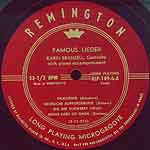
| Gabor's
first Remington releases had a red label designed in the style which looked
like that of labels like Columbia and Westminster. It bore also resemblance
with the Continental label. The label indicated that the record was pressed
on Websterlite and was licensed by Remington Records Inc., NY, USA and for
use on phonographs in homes. The covers were made of paper and reminded
of the simple sleeves of 78 RPM records except for the artwork. Instead
of liner notes there was a list of the (earliest) releases with the heading
'Music
for every mood' with Felicitas Karrer, Elisabeth (Elizabeth) Wysor,
Karin Branzell, Andor Foldes and a series of 10 inch records with popular
music which had formerly been released on Continental and 78 RPM shellac
discs. 'Copyright 1950' was printed on the sleeve. |
 |
 |
 |
 |
|
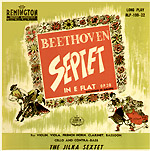
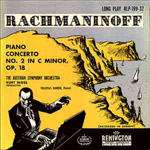
The
label was soon altered and changed into a more distinguished design. This
second series label also had a red color but now with the name Remington
in a curved logo. The covers had a design with large lettering and simple
but colorful artwork. The year of copyright on the back of the covers
of the early releases of the Rachmaninoff Concerto by Often
a generic design was used as in the case of Mendelssohn's Violin Concerto
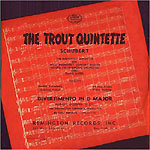
by And again Walter Schneiderhan's performance of Beethoven's Sonata for Piano and Violin Op. 30, No. 2 coupled with Beethoven's Sonata for Piano and Violin No. 8 played by Helen Airoff and Céliné Chailley-Richez). The record with reference RLP 149-3 with Willy Boskovsky suggesting that it contains Schubert's Trout Quintette is a disappointment. Billboard of 21 October, 1950, reviewed the disc:
An
interesting rarity is R-149-20 with violinist Ivry Gitlis (pupil
of Georges Enesco) who plays with passion and lyricism Paganini's Violin
Concerto in D major, Op. 6, in the arrangement by Fritz Kreisler; the
Austrian Symphony Orchestra conducted by Kurt Wöss. |
 |
 |
 |
 |
|
Later on an oval emblem was added telling the prospective buyer that the
record was of high quality. It said: "Complete Audible Range Reproduction",
probably inspired by London's "full frequency range recording". Other
record companies had a similar emblem and/or quality slogan which indicated
the nature of their business. Capitol had the "Full Dimensional Sound"
logo, RCA had "Orthophonic High Fidelity" and Mercury marked their record
sleeves (though not always rightfully) with the indication "living presence"
and later on added "margin control" on the label itself. Gabor realized that an indication of quality was necessary to add importance to the label and to give the impression that his product was to be regarded in the same class as the big labels. He stayed on the safe side with the word "Reproduction" instead of "Recording", so it all depended on the listener's audio set.
The address of the office was then 263 West 54th Street in New York.
But
soon was to be exchanged for a suite on Fifth Avenue. |
 |
 |
 |
 |
|
If
compared to the mayor labels like Columbia and RCA, the technical quality
of the pressings was not of the highest standard, to put it mildly. However
one should not forget that when Gabor started to produce his LP recordings
the hiss of the 78 RPM shellac records was still resounding in the ears
of most record collector and also in Gabor's.
|
 |
Like RCA, the inventor of the 7 inch 45 RPM disc, also Remington released 45 RPM boxed editions of complete symphonies and concertos: Beethoven's Emperor with Felicitas Karrer and (at left) Dvorak's New World Symphony. At right one of the 45 RPM Extended Play releases of opera highlights. |
 |
Copyright 1995-2009 by Rudolf A. Bruil




 Although
the technical quality of the recordings was not very high, Irving
Kolodin remarked about the 78 RPM records in "The New Guide
To Recorded Music" (Doubleday, New York, 1950): "...the inherent
value of the playing is not to be denied."
Although
the technical quality of the recordings was not very high, Irving
Kolodin remarked about the 78 RPM records in "The New Guide
To Recorded Music" (Doubleday, New York, 1950): "...the inherent
value of the playing is not to be denied."
