|

Hungarian
pianist Andor Foldes - Image taken from the cover of a Deutsche Grammophon
release.

Marta Eggerth (b. 1912) and Jan Kiepura (1902-1966) at the time when
they triumphed in New York - Picture taken from the EMI Odeon LP OPXH
1010.

Georg
Kreisler - image taken from the cover of the recording of Liebeslieder
am Ultimo - Intercord 160.120.

Juris
Doctor Marcel F. Prawy at 31 in 1943.


Famous
conductor Fritz Busch in 1942, New York.
Picture
edited by R.A.B., taken from The Etude magazine, April 1943. (SoundFountain
Archive)

The
famous recordings of Béla Bartók playing his own work
at the piano, New York, 1942.

Paul
Schöffler

Gaspar
Cassado

Hans
Wolf conducts Symphony in D by Cesar Franck.

A
few recordings produced by Marcel Prawy appeared on the Viennola label.

May
29, 1897 – November 29, 1957

Conductor
Fritz Busch.
13 March 1890 -
14 September 1951

Beethoven
Sonatas Op. 109 and 110 by Jörg Demus on RLP-199-29.
 See: Copyright
Images
of Marcel Prawy's Certificate of Nationalization and ID photograph,
and the letter of recommendation written by Don Gabor, courtesy of researcher
Franz Krahberger from Austria.

|
In
1937, twenty six year old Marcel Prawy became personal secretary to
Polish singer/actor Jan Kiepura and Hungarian operetta singer Mártha
Eggerth (also Marta Eggert, Martha Eggerth, originally Márta
Eggert).
In this function Prawy could combine his knowledge and organizational
talent with his love for music and drama. The engagement was the beginning
of a remarkable career.
Marcel
Prawy - in full Marcel Horace Frydman, Ritter von Prawy -
was born on December 29, 1911, in Vienna. The title Ritter
means Knight. And Freiherr (the title which is also
often mentioned) is the equivalent of baron. He was
born into a Jewish, Austro-Hungarian noble family which originated
from Poland.
From
an early age on music, and especially opera, was Marcel's passion.
However, after passing his gymnasium exam, he did not study music
and musicology full time at the "Viennese State Academy for Music
and Dramatic Art" (Wiener Staatsakademie für Musik und dramatische
Kunst). No, he attended the university of Vienna instead and studied
law. He became a Juris Doctor (Doctor of Law) in 1934 and practiced
in a law firm. Yet music was always on his mind. As a sideline Prawy
studied music with famous musicologist and composer Egon Wellesz (1885-1974),
who himself had studied with musicologist Guido Adler (1855-1941)
and with Arnold Schönberg (1874-1951). In 1938 Wellesz left for
Great Britain (and took up a post at the University of Oxford in 1943).
It was clear that after Wellesz had left Marcel Prawy had to decide
what he was going to do next.
|
At
right the label of the 78 RPM shellac disc with Jan Kiepura singing
"Oh Madonna!" accompanied by the Parlophon-Künstler-Orchester
(Parlophone Artists Orchestra) Dr. Weissmann conducting, reference
11 007. That was in 1934, well before Marcel Prawy became personal
secretary. 
|
|
In
1938 Jan Kiepura made his debut at the Metropolitan Opera in
New York. Marcel Prawy, now personal secretary to the famous couple,
planned to join him.
The political situation in Austria was getting grimmer and grimmer
and those who planned to leave the country should not hesitate.
As a young man, conductor
Thor
Johnson studied in Europe and followed courses and masterclasses
given by Bruno Walter and Nicolai Malko. Johnson stayed in Salzburg,
Vienna, and in Leipzig during the season of 1936-1937. In a letter
to his parents Johnson described the prewar situation in Austria:
"Austria
is one of the poorest countries of Europe. The streets are filled
with cripples and beggars and Vienna is considerably run down.
The war (WW I, ed.) certainly took its toll. The only man who
seems to have had any ability to do anything for Austria was
Dollfuss and the Nazis took his life because they realized his
importance." - Thor Johnson in a letter to his parents
dated May 23, 1937. (Thor Johnson, American Conductor, by
Louis Nicholas, 1982.)
|
And
another witness, Kitty Werthmann)*, an Austrian World War II survivor,
explained that there was 30 percent unemployment, 25 percent inflation,
25 percent interest on loans. There were winers in the streets and
housing blocks had been burned down obviously by lack of funds to
repair or to rebuild. Austria had lost World War I and was broke.
The Treaty of Versailles stipulated that Austria had to pay reparations
to the Allied Powers, so it was decided in Geneva in 1922 that Austria
had to follow an austerity course.
That was disastrous for the country. The bad economic situation gave
the Nazis a growing influence. In an attempt to counteract this, Chancellor
(Bundeskanzler) Engelbert Dollfuss had instated his dictatorship and
banned the Austrian Nazi Party and also excluded the social democrats
who often take a wrong or biased decision in the name of democracy.
Dollfuss took sides with Musolini and thus wanted to prevent a takeover
by Hitler but was assassinated on July 24, 1934. He was succeeded
by Kurt von Schuschnigg who followed the same policy and was opposed
to Hitler's plan to annex Austria. But to no avail. That is how things
stood in the second half of the 1930s.
Jan
Kiepura was a very popular artist who starred in several movies. He
was not too fluent in English and he had a heavy Polish accent when
speaking German. So his dialogues of the movies he appeared in had
to be dubbed with the voice of another actor. That actor was Robert
Valberg. After Prawy had become Kiepura's secretary he supervised
the synchronisation sessions together with Robert Valberg in
Vienna.
As Jan Kiepura was engaged at the Metropolitan Opera in New York,
migration to the US was the obvious move for Prawy to make. This became
the more urgent when on March 12, 1938, Austria was annexed by Nazi
Germany and practically immediately Jews were harrassed in the streets.
The new Nazi government meant important changes and restrictions for
all Austrian citizens. The day after the Annexation (Anschluss)
it was announced that actor Robert Valberg - with whom Prawy
had worked while synchronizing and editing Kiepura's latest movie
- was appointed Director of the Federal State's Chamber of Artists
(Landesleiter der Reichstheaterkammer) and Cultural Advisor for
the City of Vienna (Kulturbeirat der Stadt Wien). This came as
a shock to many and also to Prawy who had never suspected that the
man, with whom he was on friendly terms, was a Nazi. However, it was
that same Robert Valberg, who arranged for the necessary official
documents for Prawy to quickly leave the country. Together with Jan
Kiepura and Marta Eggerth, he left for Italy. From there
they traveled separately by boat to the United States. Prawy was registered
at Ellis Island (New York).
Strangely enough Jan Kiepura and Marcel Prawy returned to Germany
for a short while later in 1939 in order to collect important private
belongings and documents at Kiepura's address in Berlin. This undertaking
was certainly not without risk. They travelled by car and the closer
they came to Berlin, the more they realized this and decided not to
continue their trip. They did an about turn and left the country and
Europe as quickly as possible. They reached New York later in 1939.
Marcel Prawy had a permit to stay and he also obtained an affidavit
for his father, who came to America as well, but died there a few
years later. Dr. Richard Frydmann von Prawy, 1882-1942.
Since
1933 dark clouds gathered over Europe. In the years before the outbreak
of World War II, many scientists, musicians, composers, performers,
and artists fled to America. Many were well known or became famous
after the war. They were of various nationalities.
Many names were linked in some way or other to the Austrian-Hungarian-German
music culture: Robert Stolz (conductor), Oscar Strauss
(composer/conductor), Paul Abraham (composer), Emmerich
Kalman (composer), Erich Wolfgang Korngold (composer/conductor),
Béla Bartók (composer), Andor Foldes (pianist),
Fritz Busch (conductor), and many, many more. Marcel Prawy
got to know them personally and remained friends with Stolz, Korngold,
Kálmán, Strauss, and others.
Not
all were in a position to perform or have their works performed to
earn some sort of living. There were exceptions: Robert Stolz
conducted in New York. Fritz Busch led the New Opera Company,
Martha Eggert and Jan Kiepura sang at the Met. In 1940
Mártha Eggerth sang in the Broadway musical Higher and Higher.
In the 1943-1944 season the couple played in the Broadway production
of the operetta The Merry Widow (Die Lustige Witwe by Franz
Lehar). Martha Eggerth also went to Hollywood. She appeared in For
Me And My Gall (1942) as Eve Minard, and in Presenting Lilly
Mars (1943) as Isobel Rekay.
Many
immigrants produced cultural gatherings for other immigrants in New
York, and with success. Donald Gabor knew Martha Eggert and he asked
her to make a few recordings for his Continental label which he later
released on Continental CLP 2012.
Gabor also recorded pianist Andor Foldes. And he made the now
famous recordings of Béla Bartók and his wife
Ditta Pásztory in their home in New York.
It was through Marta Eggert that Donald Gabor met Marcel Prawy, a
meeting which would have great consequencies several years later.
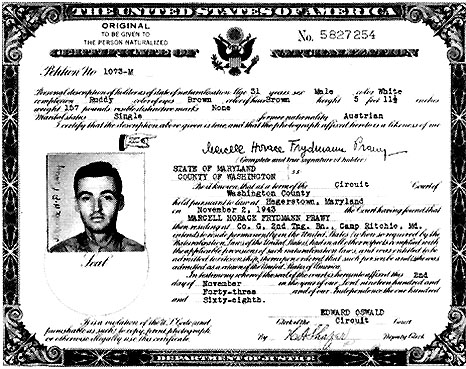
The
United States of America Certificate of Nationalization of Marcel
Prawy (white, male, ruddy complexion, 5 foot 11.5 inches tall) was
issued on November 2, 1943 in Maryland.
Like
George Curtiss (later director of the New England Record Corporation
in Webster, Massachusetts), also Marcel Prawy enlisted in the US Army
in 1943 and obtained US citizenship. From then on Prawy was no longer
secretary of the famous movie couple, but became an instructor in
the army. He taught languages, history, and customs of European countries
to recruits so they would be prepared when they came to Europe.
In
1944 Prawy was first sent to England were he entertained the American
troops together with cabarettist/pianist/composer Georg Kreisler
(a sample of the latter's art are the "Nichtarische Arien"
- Not Arian Arias - recorded in 1966). From England Prawy went to
Paris. There too Prawy and Kreisler performed their musical reviews
they partly had written together.
When
the Germans had finally capitulated in May 1945, Prawy was stationed
in Germany and for a short while in Bordeaux in France. In 1946 he
returned to Vienna. From May 1946 till 1950 he was a "military
civilian" and as such became editor of "Welt im Film"
(The World in Pictures), the adaptation of the American-British
news reel, to which he added more items about music than about
politics, he later confessed in his book "Marcel Prawy erzählt
aus seinem Leben" (Marcel Prawy talks about his life).
|
|
|
Marcel
Prawy in the nineteen seventies when he prepared a special
Series of LPs for Deutsche Grammophon containing Opera Highlights
taken from recordings of complete operas from the DGG catalog.
Picture
taken from Deutsche Grammophon Lp 2532 001 - Wagner: Tristan
und Isolde.
Photo credit: Will Appelt, Wien.
|
Marcel
Prawy produced many recordings on his own account like 'Rêve
de valse' (Ein Walzertraum, Dreamwaltz) by Oscar Srauss, released
in France on Counterpoint CMC 120.001, the composer conducting
the 'Tonkünstlerorchester', listed in 1955. The actual
conductor in this recording is not Oscar Strauss who was already
very old, yet very satisfied with the way
Max
Schönherr conducted the music.
|
The
conversations between Donald Gabor and Marcel Prawy in New York resonated
at the end of the nineteen forties when Gabor contacted Prawy and
asked him to produce recordings to be released on his newly founded
Remington Records label. They made a deal.
From 1950 on Prawy produced numerous recordings with the Orchestra
of the Viennese Symphonic Society which is also called Austrian Symphony
Orchestra, Niederösterreichisches Sinfonieorchester (Symphony
Orchestra of Lower Austria), and Tonkünstler Orchester.
When
Prawy mentioned in his correspondence the recordings made with Gaspar
Cassado, Kurt Wöss and George Singer, he calls the orchestra
"Vienna Pro Arte Orchestra". He had a two year contract
with the orchestra. Conductors were Fritz Busch, Hine Arthur Brown,
Kurt Wöss, Wilhelm Loibner, Gustav Koslik, Felix Prohaska, Paul
Walter, George Singer, Anton Paulik, Max Schönherr, and
Hans
Wolf, to name a few. And he had a contract with the Orchestra
of the Salzburg Mozarteum.
About
his productions, Prawy wrote in a letter dated July 31, 1950:
After
three years of military duty with the U.S.Army (1943-1946) and
three years civilian duty with Military Government for Austria
(1946-1949, Assistant Films Officer for Austria) I am now executive
employee with Continental Record Company Inc.(...)
My weekly earnings since my separation from Military Government
have averaged ATS (Austrian Schilling) 100. They are
bound to take a sharp increase as I am working on salary plus
commission and have produced in the last months approximately
80 records which will go on sale in August only with 10% for
me in addition to my salary.
|
The
first batch of recordings was released in the fall of 1950, and certainly
not all eighty productions. Prawy also made deals with performing
artists and artists of the younger generation, those who just had
finished their studies in Vienna.
Prawy even asked conductor Paul Sacher to make recordings for
the Remington label and, in a letter, tried to convince him by mentioning
that recordings had been made with George Enesco; Bela Bartok interpreting
his own compositions; Giuseppe de Luca singing arias; Walter Schneiderhan
playing Mendelssohn`s Violin Concerto and Beethoven Sonatas; Giovanni
Martinelli and Karin Branzell singing arias and songs; Andor Foldes
with a special piano album; Robert Stolz conducting his own works;
Jan Kiepura in The Merry Widow (Lustige Witwe); Oscar Strauss conducting
Viennese music; and a series of "great symphonies conducted
by the excellent conductor"
H.
Arthur Brown had been completed.
Prawy
talked as if he was involved with the Bartok, Enesco and Foldes recordings
which were made by Don Gabor in America. However, he could have been
present when Bartok and Foldes made the recordings. It is known that
Prawy was an able negotiator and also someone who liked to give importance
to himself as well as the cause he was working for. In this case Continental
Records Inc.
Marcel
Prawy discovered and contracted pianist Jörg Demus for
his first recordings ever, with works of Bach, Beethoven, Chopin and
Schubert. Prawy also approached young pianist Alexander Jenner
who, in 1949, had won the "Bösendorfer-Preisflügel" (Bösendorfer
Grand Piano Prize), which was awarded by the famous Viennese piano
manufacturer to the best student. It was the obvious recommendation
to have Alexander Jenner to make his debut recordings for Remington.
Alexander Jenner told me: "Mr. Prawy would ask you to study,
say Beethoven's 'Diabelli Variations', and to be ready in two weeks
time for a recording session."
The
sessions arranged by Prawy in Vienna produced material to be released
on the Remington label for which also pianists Frieda Valenzi,
Hilde Somer,
Fritz Weidlich, and Felicitas
Karrer performed. These recordings were often released on Gabor's
Plymouth and Merit labels as well. Prawy recorded cellists Gaspar
Cassado and Richard Matuschka, and violinists Michèle
Auclair, Eva Hitzker, Helen Airoff, Walter Schneiderhan, and
Gérard Poulet. He made recordings or obtained radio recordings
of the many artists who can be found on the Remington releases starting
at R-199-1 with pianist Felicitas Karrer performing Beethoven's Emperor
Concerto, up to and about R-199-128 on which Michèle Auclair
plays 'Kreisler Favorites' and Gaspar Cassado plays 'Cello Encores.
And there is R-199-130, the record of Gustav Koslik conducting the
Austrian Symphony Orchestra in 'Polovetsian Dances' from Prince Igor
(Borodin) and 'Night on Bald Mountain' (Mussorgsky).
|
|
|
|
The
first "Fritz Busch Album", a gatefold with the recordings
of Beethoven's Symphony No. 8 and Joseph Haydn's "The Clock"
appeared in the luxurious series with crocodile skin pattern.
After Fritz Busch had died these recordings were available
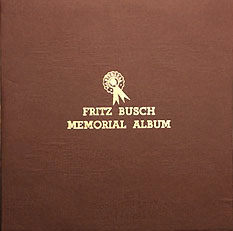
as the "Fritz Busch Memorial Album" in a differently
styled cover. Both releases had the reference number MW 39.
|
|
| |
Another release was with baritone Paul Schoeffler (who
sang at the Wiener Staatsoper fromn 1937 till 1965) and cellist
Gaspar Cassado.
|
|
|
|
|
A
unique recording of Volkmar Andreae at 70 years of age:
Bruckner's Symphony No. 1 on Masterseal MW-40, released in the
Fall of 1951
|
Vittorio
Gui conducts Mendelssohn Bartholdy's 'Reformation Symphony'
(No. 5) and Hebrides Overture. MW-49, released in August of
1952
|
Masterseal
MW 46:
Korngold
by Korngold, released in the Spring of 1952
All
luxurious Masterseal editions
bear the emblem
"A Marcel Prawy Production".
|
|
|
Varèse-Sarabande
issued VC 81040 with the tapes from which the original Masterseal
MW 46 was cut. It is likely that the recordings of the Masterseal
LP were produced for the Austrian Broadcasting Services by Marcel
Prawy together with Erich Wolfgang von Korngold himself. The
luxurious Masterseal bears the emblem "A Marcel Prawy Production".
|
|
|
The
Srauss Dynasty - Music by the various members of the Strauss
family conducted by Oscar Strauss who also lived in New York
during World War Two. Masterseal MW-48. But apparently not at
all conducted by Oscar Strauss but by Clemens Krauss, Max Schönherr,
Kurt Wöss, Robert Stolz, Felix Guenther.
|
|
A
few of Prawy's productions were released on the Masterseal
label in the early years. These were special editions not styled by
Alex Steinweiss or another artist who would be in charge. The records
were offered in luxurious gatefold covers with a luxurious snake skin
pattern and liner notes originally written by Marcel Prawy
himself. The most famous ones are the Busch Memorial Album, and the
recording with cellist Gaspar Cassado playing gems and accompanying
baritone Paul Schoeffler (Masterseal MW-45). On Masterseal
MW-49 it is Vittorio Gui who conducts Mendelssohn Bartholdy's
'Reformation Symphony' and Hebrides Overture released in the Summer
of 1952, and on Masterseal MW-50 he conducts Great Overtures of Rossini,
Cherubini and Wolf-Ferrari. The pressings were done on quality vinyl,
not the cheap substitute used for the Remingtons. Therefor prices
were high, $6.45 for a 12 inch LP record.
|
|
|
Marcel
Prawy miming a gesture with his left hand as saying "Attention...
here is the passage"
From
right to left: Dr. Hans Sachs, Marcel Prawy, Prof. Fritz Busch,
and two unidentified persons (probably an official of the orchestra
and a recording technician) during the playback of a recording.
Image courtesy KHM-Museumsverband, Vienna.
Copyright http://www.theatermuseum.at/
|
Other Masterseal releases were Bruckner's Symphony No. 1 with conductor
Volkmar Andreae (Masterseal MW-40); "Erich Wolfgang
Korngold plays Korngold", an LP on which the composer plays
the piano, and soprano Hilde Zadek and tenor Anton Dermota
sing, while Wilhelm Loibner conducts the "Austrian State
Symphony" (Masterseal MW-46). On MW-42 Vittorio Gui conducts
"Great German Overtures". And there are the recordings by
Oscar Strauss on MW-47 and 48, and of course the
Fritz Busch Memorial Album (MW-39).
All special recordings.
|
|
|
|
Many
recordings were re-released on the Vibraton label in the nineteen
sixties and seventies. These records were pressed in Italy from
new matrices on a better quality vinyl.
|
The
special Masterseal series with noteworthy recordings produced
by Marcel Prawy all bore an emblem with his name instead of
the name of Donald H. Gabor.
|
The
collaboration between Marcel Prawy and Don Gabor lasted until the
beginning of 1953. It was then that Donald was offered to have Berlin
as the main recording venue and tape performances of the
RIAS Symphony Orchestra.
Marcel Prawy writes in his biography:
"(...)
between 1950 and 1955, I made many recordings, mostly for
the American firm "Remington", of which Donald and
Wally Gabor from New York were the founders, who, for the
first time, wanted to release a budget series of the newly
invented LP. I made many records on my own account. There
was a contract with the 'Niederösterreichisches Tonkünstlerorchester'.
(...) On my records conducted the great conductors Fritz Busch
and Vittorio Gui. Anton Dermota, Paul Schoeffler, Astrid Varnay
were singing."
|
In
the beginning several records were produced together with conductor
Hans Wolf who also had fled to America and had enlisted in the US
Army. After World War II Hans Wolf (1913-2005) had come back
to Europe, but returned to the US for good after making recording
six works for the Remington label, among others César Franck's
Symphony in D, Ludwig van Beethoven's Fifth Symphony, Symphony No.
2 by Johannes Brahms, and Wolfgang Amadeus Mozart's "Haffner"
Symphony, all with "The Austrian Symphony Orchestra".
And he recorded Haydn's Cello Concerto with Gaspar Cassado.
It
truly was a budget series. The Remington recordings made in Austria
give evidence that Prawy was more concerned about recording an artist,
an orchestra, the composition, and adding another work to his and
Gabor's catalog, than he cared about the quality of the sound recording
per se. Prawy tried to sell his recordings also to radio stations
in Sweden and Germany (RIAS), and to other recording companies in
England and the USA (Capitol) but to no avail.
When
the collaboration with Remington Records had ended,
Donald Gabor wrote a Letter of
Recommendation on the stationery of his
Record
Corporation of New England, Webster, Massachusetts:
|
|
January
14, 1954
TO
WHOM IT MAY CONCERN:
This
is to certify that Mr. Marcel Prawy was employed as director
and producer of musical recordings by our division, Remington
Records, Inc.
Mr.
Prawy started for us on January 17, 1950 and was employed until
December 1953 and was paid on a weekly basis the sum of $500.
We
were extremely satisfied with Mr. Prawy's unique talent and
loyalty and it is a pleasure to recommend him for any position
which he would undertake."
Very
truly yours,
Donald H. Gabor,
President.
|
The
conversion rate of the US$ to Austrian Schilling was 1 to 20 at the
time. The weekly payment of $500 was about 10.000 Austrian Schillings
in 1951, and even more on the black market. Prawy had to pay orchestras,
conductors, musicians, technicians, rent recording venues and pay
for additional production costs. Counting the data given in 'Die Tonkünstler'
(the history of the orchestra from 1907 until 2007 the year of publication
by Residenz Velag in Vienna) it shows that there were 145 sessions
led by Marcel Prawy. It is clear that his business with Gabor made
him a well-to-do man.
December
1953 is the end of Prawy's contract. The recordings of the Beethoven
and Brahms Violin Concertos performed by American violinist
Albert
Spalding were recorded one year earlier, in November 1952.
These recordings were produced by Laszlo Halasz who had travelled
to Vienna to supervise the recordings. It is understood that Marcel
Prawy was co-producer.
After
the contract with Gabor had ended, Prawy tried to sell his "musical
recordings" to radio stations and other interested parties but
without significant success. It is clear that Remington was the only
record company who released his recordings apart from a few recordings
issued in Germany (on the Opera label, Bertelsmann) and in France
(on Counterpoint).
These
early years of producing were significant for Prawy's later career
and his experiences paid off. In 1955 he became a member of the board
of directors of the 'Volksoper' and he dared to introduce 'the musical'
to the conservative Viennese public by staging Cole Porter's 'Kiss
me Kate', followed by Leonard Bernstein's 'Wonderful Town' (1956),
Irving Berlin's 'Annie, Get your Gun' (1957), and Leonard Bernstein's
'West Side Story' (1968), and many more.
|
|
|
Leontyne
Price and
William Warfield.
Picture taken from the RCA LP release with highlights from Porgy
and Bess.
|
In
1952 the American Opera Company toured Europe performing George Gershwin's
Porgy and Bess and also visited Vienna. Prawy had first seen
'Porgy and Bess', the revival production, in New York in 1942 and
he could have seen the 1944 production at the New York City Center
before he, as an information officer, was sent back to Europe with
the US Army. In that 1952 production the role of Porgy was played
and sung by William Warfield whom Prawy had met in the army.
Bess was the young and newly discovered star, soprano Leontyne
Price. It was the first Blevins Davis/ Robert Breen production.
(The second production of Porgy and Bess toured Europe one year later,
in 1956).
|
|
|
This
picture appeared in Etude Magazine of July, 1955. The caption
reads, "Maestro Ormandy and William Warfield, noted Negro
baritone, with several orchestra members about to board their
plane." The Philadelphia Orchestra flew to Europe with KLM,
Royal Dutch Airlines, as is indicated by the lettering "The Flying
Dutchman" above the windows.
|
And
it is likely that William Warfield also came to Vienna in 1955 when
the Philadelphia Orchestra and conductor Eugene Ormandy toured Europe
and visited the Austrian capital. An article in Etude Magazine of
July, 1955, mentions: "William Warfield, baritone and the only
American soloist to accompany the orchestra, was the featured artist
in seven (...) programs."
Ten
years later, in 1965, Marcel Prawy himself produced 'Porgy and Bess'
with the Wiener Volksoper. It was the complete, original version and
the first complete version since the premiere in Boston. Therefor
it is said that Marcel Prawy set the trend to perform 'Porgy and Bess'
as a full length opera and not as an abbreviated musical, already
many years before the Metropolitain Opera did. In that production
of 1965 Olive Moorefield was Bess. Porgy was again Prawy's army friend
William Warfield.
Marcel
Prawy's recollection:
"I owe a deep insight into the creativity
of George Gershwin to a wonderful man with whom I became friends
in New York. There his name was Albert Sirmai (originally written
as Szirmay, ed.) (...) managing director of the famous Chappell
Publishing Company and who earlier had been in close collaboration
with George Gershwin. Nearly all Gershwin's piano scores show
his name as a publisher. Countless times I have visited him
after office hours at Chapell's and did not get tired to listen
to his stories about George Gershwin. Because of his inadequate
classical music studies, Gershwin suffered from poor selfesteem,
and was a Wagnerian, and Sirmai had always to explain the technique
of the 'Leitmotiv' (leading motif) of his idol. He (Sirmai.
ed.) once showed me a 'Meistersinger' opera vocal score with
Gershwin's written remarks. "Porgy" is indeed
the only opera which exists with the most 'leading motifs' ever.
The premiere performance in the year 1935 in the Alvin Theatre
was no good - except for the leading performers Todd Duncan
and Anne Brown. And when I came to America in 1939 people still
said to me (...) that Porgy, the last (composition) of Gershwin,
was nothing.(...) Than they remodeled "Porgy and Bess",
inserted spoken dialog (these are hardly present in the original),
the heavy chorusses were abridged, and changed it into a musical.
That was an immense triumph in 1942. (...) I was present. Suddenly
there was a musical which had less similarity with Gershwin's
opera, but had started a triumphant tour.
I
was the first who said to director Moser of the "Volksoper":
"What in fact about the original which was never performed?
As an opera house we have all the possibilities - Gershwin never
did have these. Why don't we do that for the first time in Vienna?"
Moser agreed. And in 1965 we did produce for the first time
the original score of "Porgy and Bess", as a large,
heavy opera with a large orchestra, big chorusses, with these
difficult things to sing, for the first time in the world on
October 19, 1965, at the Volksoper. (Olive) Moorefield was Bess,
William Warfield Porgy, and I was very proud of the headline
in an American newspaper: "Vienna gave Gershwin what America
did refuse him." - Marcel Prawy
See
also
Porgy
and Bess)
Albert
Sirmai (2 July 1880 –15 January 1967) was a Hungarian composer
of songs and operettas who went to live in the US in 1923.
|
Prawy's
career was gaining more and more importance. He became a famous television
presenter and as such was nicknamed 'Mister Oper'. He supervised and
compiled a series of opera records for Deutsche Grammophon, engaged
famous stars and discovered new talents. He wrote many books and was
dramaturg at the State Opera (Staatsoper). He was one of Vienna's
most remarkable figures who left an imprint on the cultural life and
on the lives of many artists, opera singers, conductors, musicians,
stars, and in the early nineteen fifties on Gabor's Remington Records.
Like
mystery writer Cornell Woolrich (author of 'The Window' and 'Rear
Window'), also Marcel Prawy considered living in a hotel the best
way to be able to dedicate himself fully to his work. He may have
taken up the habit when changing from one cheap hotel to another during
his stay in New York from 1938 until 1943, he has been living in hotels
ever since. He passed away on February 23, 2003, in Vienna, at the
age of 91, leaving numerous documents, books, photographs and objets,
all documenting the history of his own life and the musical and cultural
history of Vienna over many decades.
In
the nineteen thirties tenor Jan Kiepura predicted that Marcel
Prawy was going to have a great career. And indeed he was.
Placido Domingo described Prawy as "an authority for everything
concerning music". And that was also very true.
Text written by
Rudolf A. Bruil - Page first published in December 2006.
Facts about Marcel Prawy's work for Jan Kiepura, his stay in the USA
and a quotation, were taken from the book "Marcel Prawy erzählt
aus seinem Leben" (Marcel Prawy talks about his life), Kremayr
& Scheriau, Vienna, 2001.
 Since
1938 Jan Kiepura and Martha Eggerth lived in the United States.
Since
1938 Jan Kiepura and Martha Eggerth lived in the United States.
In 1966 Jan Kiepura died from heart failure. In 2002 Marcel Prawy
invited Martha Eggerth right after her 90th birthday to come to Vienna
to be honored at a Gala Performance. On the 27th of December 2013
the media reported that Martha Eggerth had died at the age of 101
in her home in Rye, north of New York.
)*
Kitty
Werthmann's testimony was added in 2016 to this page.
Watch  YouTube
|