Very
well played and extremely well recorded: Saint-Saëns (Carnaval
des animaux) and Tchaikovsky (Swan Lake) conducted by Jonel Perlea:
R-199-160.

The
original R-199-11 Scheherazade recording of H. Arthur Brown which
was to be replaced by the Karl Rucht performance.
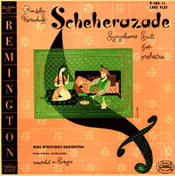
The second cover
was used for both the H. Arthur Brown and Karl Rucht releases with
the same reference number.


R-199-254,
the release of R-199-172 in a new cover.



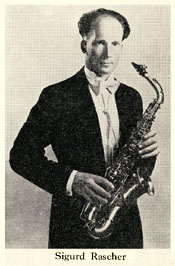
Sigurd
Rasher around 1950.

On
Bertelsmann Schallplattenring 8135 a variety of Remington artists can
be heard: Wolfgang Sawallisch, Alexander Jenner, Karl Rucht and Laszlo
Halasz.


Johanna
Martzy plays Violin Concerto of Antonin Dvorak on LPM 18152

Rossini
'Stabat Mater' and Kodaly 'Psalmus Hungaricus' on 2 LPs: 18 203/04 LPM

A
later release of Kodaly 'Psalmus Hungaricus' on a single disc coupled
with Symphony of Psalms - LPM 19073

Ferenc
Fricsay around 1952. Image taken from the back of the early LP 18012
- with blue linen spine - of Tchaikovsky's Fifth Symphony with the RIAS
Symphony Orchestra.

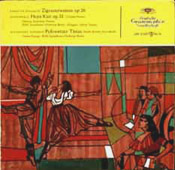
'Zigeunerweisen'
(Gypsy Airs) Op.20 (Pablo de Sarasate) and 'Hejre Kati' (Jenö Hubay)
on 45 RPM - 30 089 EPL and on 17 071 LPE (coupled with Polovetsian Dances
from Prince Igor - Borodin)
|
When in the September 1954 edition of High Fidelity Magazine
the first Remington record with the RIAS Symphony Orchestra was reviewed,
many a critical collector was surprised that an orchestra of this
stature was recording for Don Gabor's Remington Records. 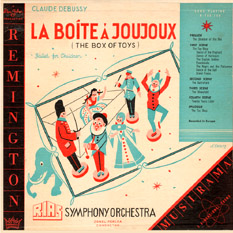 The
orchestra was conducted by Jonel Perlea and played La Boîte à joujoux
(Claude Debussy) on R-199-159. Reviewer J.F. Indcox wrote: "Jonel
Perlea directs a sensitive performance and we get some really excellent
orchestral sound from Remington." The
orchestra was conducted by Jonel Perlea and played La Boîte à joujoux
(Claude Debussy) on R-199-159. Reviewer J.F. Indcox wrote: "Jonel
Perlea directs a sensitive performance and we get some really excellent
orchestral sound from Remington."
The
RIAS Symphony (Symphonie-Orchester) had actually been Ferenc Fricsay's
orchestra and, since 1948, had been molded and shaped by this great
Hungarian conductor into an excellently sounding and performing group
of musicians. By 1953 the orchestra had already made recordings for
the Deutsche Grammophon label and was going to make many more.
What
were the circumstances leading up to the appearance of the RIAS Symphony
Orchestra on a budget label like Remington Records?
 CHOOSE A SUBJECT
History
In
Berlin, on the 7th of February 1946, the 'Drahtfunk im Amerikanischen
Sektor' (DIAS=Wire Broadcasting in American Sector) is founded. Initially
radio broadcast programs are transmitted via the telephone cable.
But many telephone lines had been destroyed. So it is decided that
as of September of that same year the programs are being broadcast
over the air, and DIAS is renamed RIAS (Radio In American Sector /
Radio im Amerikanischen Sektor). This radio station is in need of
orchestras for broadcasting music programs, not only for popular music,
but for the classical repertory as well.
After
World War II, in all regions (States, Länder) of Germany existing
orchestras are being regrouped and new orchestras are founded on the
instigation of the Allied Forces which are in control of public life
and many institutions.
In Hamburg Das Sinfonieorchester des Norddeutschen Rundfunks, or
NDR Sinfonieorchester (also known as 'Sinfonie-Orchester des
Nordwestdeutschen Rundfunks' as is printed on the cover of Telefunken
LE 6505 from 1954). That orchestra is founded in 1945 and its conductor
is Hans-Schmidt-Isserstedt. Not to be confounded with Die
Nordwestdeutsche Philharmonie (based in Herford) of which Wilhelm
Schüchter is the conductor from 1953 till 1955 and makes
many recordings issued on the Imperial label.
|
|
|
An early image of Hans Schmidt-Isserstedt and "his"
NDR Symphony Orchestra.
It is obvious that on this edited image
- taken from the cover of the recording of Dvorak's New World
Symphony from 1954 (Telefunken LE 6505) - Hans Schmidt-Isserstedt
is the conductor. The same photo was printed on the cover of the
LP edition of Eroica Symphony (Beethoven) with Willem Mengelberg
and the Concertgebouw Orchestra. recorded on 11 to 13 of November,
1940 (LSK 7006).
.
|
|
|
|
'Die
Nordwestdeutsche Philharmonie' under Wilhelm Schüchter made
recordings for the Imperial label with Max Kayser (violinist),
Xenia Prochorowa (pianist), Siegfried Palm (cellist), and
Heinrich Geuser (clarinettist).
The above image is taken from the cover of ILP
116 with works by George Gershwin, Richard Addinsel and Morton
Gould.
|
In
Stuttgart the new orchestra is the Symphony Orchestra of the Southwest
Radio (Radio-Sinfonieorchester Stuttgart des SWR - Südwestfunk).
In Bavaria it is the Orchestra of the Bavarian Radio (Symphonieorchester
des Bayerischen Rundfunks) founded in 1949. Its first conductor is
Professor Eugen Jochum.
Just to mention a few.
In
Berlin the 'RIAS Symphonie Orchester' is founded on the 15th
of November 1946. It is the radio orchestra which has its home in
the American Sector of Berlin and it is financed by the Americans,
in fact by the US governement. After nearly a year of selecting musicians
and rehearsing, the first concert is given in the Titania Palast.
The conductor is Walter Sieber, a known composer, especially
of many film scores. Some time later Sergiu Celebidache conducts
'an all Gershwin program' which immediately puts the orchestra on
the map.
|
|
|
This
edited picture of a RIAS microphone was taken from the cover
of Europäischer Phonoklub Opera release 3112. It is the
recording of violinist "Adolf Wreege mit seinem RIAS-Orchester".
It is a Neumann CMV 3 condenser microphone well known as 'bottle
microphone'.
|
Director
of the classical music division of the radio station is  Elsa
Schiller, a pupil of Ernö Dohnányi.
She was soon to become the famous recording producer for Deutsche
Grammophon Gesellschaft and it is Schiller who persuades Ferenc
Fricsay to come to Berlin. In 1948 he signs a contract with the
RIAS Symphony Orchestra and practically at the same time a contract
with Deutsche Grammophon Gesellschaft.
Elsa
Schiller, a pupil of Ernö Dohnányi.
She was soon to become the famous recording producer for Deutsche
Grammophon Gesellschaft and it is Schiller who persuades Ferenc
Fricsay to come to Berlin. In 1948 he signs a contract with the
RIAS Symphony Orchestra and practically at the same time a contract
with Deutsche Grammophon Gesellschaft.
Ferenc
Fricsay not only has a taste for the works of a variety of classical
composers - and especially Beethoven and Mozart - but he also is the
man who establishes a modern repertory with compositions of Béla
Bartók, Alban Berg, Boris Blacher, Paul Hindemith, Zoltán
Kodály, Arnold Schönberg, Igor Stravinsky, Gottfried Von Einem,
Werner Egk, Frank Martin and Alexander Tcherepnin.
Thus
the RIAS Symphony Orchestra also becomes the exemplary institution
to perform what was then regarded as "contemporary music".
No wonder that works of most of these composers can be found on early
recordings of the Deutsche Grammophon Gesellschaft label. Already
in those days several recordings are taped in the Jesus Christus Kirche,
not just because of its acoustics but also because that is most probably
the only alternative to the Titania Palast which is also in use by
the Berlin Philharmonic Orchestra.
Ferenc
Fricsay
performs with his RIAS orchestra in concert with pianists Géza Anda,
Claudio Arrau, Walter Gieseking, Friedrich Gulda, Margit Weber, and
Clara Haskil; with violinists Yehudi Menuhin, Wolfgang Schneiderhan
and Tibor Varga; with violoncellist Pierre Fournier; and with singers
like Maria Stader, Rita Streich, Josef Greindl, Ernst Haefliger and
Dietrich Fischer-Dieskau.
 In
1947 Yehudi Menuhin performed with the Berlin Philharmonic
Orchestra under conductor Wilhelm Furtwängler. This performance
by a Jewish violinist just two years after the war had ended
and of all places in Berlin, the center of the former NAZI
government, was regarded as very controversial and received
severe criticism. 1947 is also the year that Wilhelm Furtwängler
had been cleared from the allegation to have collaborated
with the NAZIs. In
1947 Yehudi Menuhin performed with the Berlin Philharmonic
Orchestra under conductor Wilhelm Furtwängler. This performance
by a Jewish violinist just two years after the war had ended
and of all places in Berlin, the center of the former NAZI
government, was regarded as very controversial and received
severe criticism. 1947 is also the year that Wilhelm Furtwängler
had been cleared from the allegation to have collaborated
with the NAZIs.
But
by performing in the destructed city of Berlin with the de-nazified
Furtwängler, Yehudi Menuhin sent a strong message to
the world: We have to look forward. Not only that, but he
certainly indicated that many had suffered during the years
of the Third Reich and were opposed to the fascist regime.
In 1949 Yehudi Menuhin again performed in Berlin, but
now with the RIAS Symphony on August 23, when he played
the solo part in Tchaikovsky's Violin Concerto, Ferenc
Fricsay conducting. This historical performance was a
radio broadcast. It was later issued on LP No. 29
in the Italian series produced by Longanesi Periodici 'I
grandi Concerti'.

His
recordings for Electrola (EMI) of the Beethoven Violin Concerto
in London with the Philharmonia Orchestra, and the Mendelssohn
Concerto recorded in May 1952 with the Berliner Philharmoniker,
both conducted by Wilhelm Furtwaengler, were a natural
consequence of his stance.
Both performances were of a high caliber. The above photograph
shows Yehudi Menuhin and Wilhelm Furtwaengler listening to
a playback. The photograph was taken by
Alice
Pashkus whose walking stick (that she used after she
had been in a car accident) shows up in the photograph as
a shadow on the wall. (Image courtesy Yorgos Manessis from
Greece.) - R.A.B.
|
However,
it appears that maintaining the RIAS Orchestra is a costly affair,
even if the general economic situation is somewhat improving. The
orchestra has an enormous financial deficit. On top of that the
Americans do realize that their RIAS Symphony Orchestra is in fact
the only orchestra which is subsidized by the American government.
Subsidizing an orchestra is simply not done in the USA.
In
July 1953 it is decided that the budget should be cut. In fact the
US is to stop financing the orchestra alltogether. That is why Ferenc
Fricsay is forced to give up his post of principal conductor because
the orchestra is simply no longer in the position to pay his salary.
In early 1954 Fricsay takes up the post of conductor of the Orchestra
of the Bavarian Radio (Sinfonieorchester / Symphonie-Orchester des
Bayerischen Rundfunks) which was founded by Eugen Jochum in 1949 in
Munich. Now several musicians leave the RIAS orchestra and those who
remain get paid by the hour for rehearsal time and performances.
|
|
Rita
Streich sings with the RIAS Children's Chorus (Kinderchor) and
the RIAS Symphony Orchestra conducted by Kurt Goebel "Von
Hirten und der Heiligen Nacht" on Deutsche Grammophon 45
RPM Variable Grade (Extended Play) 30062.
|
|
Another
recording of Rita Streich with the RIAS Symphony on a 7"
Deutsche Grammophon 30 401 EPL is of "Schon ein Mädchen
von fünfzehn Jahren" (Mozart, Cosi fan tutte - Herbert
Sandberg conducting). "Kommt ein schlanker Bursch gegangen"
(Weber, Der Freischütz - Artur Rother, conductor), and
"Gleitender Mond" (Dvorak, Russalka - Kurt Gaebel
conducting).
|
|
The
only way to keep the RIAS Symphony Orchestra alive is by hiring guest
conductors for singular concert performances and by earning extra
money by way of making commercial recordings with record companies.
One of these is the Hannover-based Deutsche Grammophon Gesellschaft
who continues to make recordings with the orchestra, generally
with Fricsay, but also a few with Herbert Sandberg, Artur Rother,
Wolfgang Rennert, Ferdinand Leitner, Richard Kraus, Vilnus Komor and
Kurt Goebel.

Herbert
Sandberg conducts Suite Aus Holbergs Zeit (From Hoberg's Time) on Deutsche
Grammophon 17046 LPE.
A
few recordings are made by Telefunken, again with Artur Rother (Liszt,
Mendelssohn, Verdi).
A
rare recording is Deutsche Grammophon LPM 18 222 with Fritz Lehman
and cellist Enrico Mainardi playing the Cello Concertos of
Robert Schumann (with RIAS Symphony Orchestra) and Joseph Haydn (with
Berlin Philharmonic Orchestra). The Schumann recording is later attrubuted
by some to Radio Symphony Orchestra Berlin, probably because this
recording was issued in 1956 when the name of the orchestra had already
been changed.

The
RIAS logo designed by Rolf Schloesser as it was printed on the cover
of Kilenyi's recording of works by Franz Liszt.
CHOOSE
ANOTHER SUBJECT
Remington
Strange
as it may seem, there is another record company who makes use
of the RIAS Symphony and that is Don Gabor's Remington Records
Inc., New York. Gabor was tipped by US government people, probably
a Senator who represented a New York county, or the entire state,
about the possibility to hire the orchestra by the hour and making
quality recordings for relatively low fees. Every strong dollar is
worth a lot in the destructed Germany.
Fact
is that Don Gabor does not buy ready tapes, and if he buys a tape,
it is not of obscure and illegal origin, as so many music lovers,
competing companies end critics suspected. In those early years of
the long playing record, Gabor's Remington Records is one of the largest
independent labels (if not the largest independent label) with a significant
turnover. Gabor is well able to hire this genuine and well trained,
virtuoso orchestra of professional musicians. Furthermore able conductors
and soloists are hired by the new Recording Director Laszlo Halasz
who knows most of them personally.
Naturally
the recordings are made under the supervision of
Laszlo Halasz
who, after a disagreement with the board of directors, left the New
York City Opera Company in 1952, the company he himself had founded
in 1943. Although Halasz was involved in earlier Remington productions,
he now officially is Recording Director of Remington Records. Many
a recording session is also attended by
Donald Gabor
himself.
Heinrich
Köhler is principal cellist of the
RIAS Symphony Orchestra from as early as the season of 1949/50 and
he stays with the orchestra until 1995. He witnesses the artistic
rise of the orchestra under Ferenc Fricsay, the financial troubles
from 1953 on, and the resurrection of the orchestra as Radio Symphonie
Orchester (RSO Berlin). Mr. Köhler remembers the many recording sessions
for Deutsche Grammophon, and of course also those for the Remington
label. He recalls that in a three hour session at least one hour ready
music was to be rehearsed and recorded on tape by the Remington people.
This tight schedule led - at least at one time - to a more or less
hilarious happening with conductor Günther Wand. Mr. Köhler recalls:
"In
a three hour session at least one hour ready music should be
recorded on tape. Unknown conductors acquitted with difficulty
their tasks. At one time Günter Wand stood in front of
the orchestra; already at that time he was a feared perfectionist.
He explained a lot of the music while rehearsing and he shaped
every detail. (Even at his old age his interpretations are mind-blowing.)
When Günter Wand wanted to record the same passage again
because he wanted a better take, recording director Laszlo Halasz
had enough of it and said: "Hey man, we already have that on
tape". Günter Wand put down his baton, took his
hat and coat, and left. The
recording sessions for Remington records had a rather business
like character. For example a work was played through and recorded
in the same session and the title was ready: The next piece
please!" - Heinrich Köhler
|
Halasz knew of course many colleagues and performing artists. In
collaboration with Bertelsmann Schallplattenring he hires a host of
conductors and soloists. Relatively unknown to record collectors in
the early mono days are Wolfgang Sawallisch, Manuel Rosenthal (1904-2003),
George Sebastian (1903-1989), Georg Ludwig Jochum (1909-1971;
brother of famous Eugen Jochum and less famous Otto Jochum who was
a composer), Otto Matzerath (1914-1963), and Jussi Jalas
(1908-1985; born Armas Jussi Veikko Blomstedt, changed his name
to Jussi Jalas in 1943 and married Margareta, daughter of Jean Sibelius).
The only real veterans are Jonel Perlea (1900-1970), Anatole
Fistoulari (1907-1995) and Leopold Ludwig (1908-1979),
one could say.
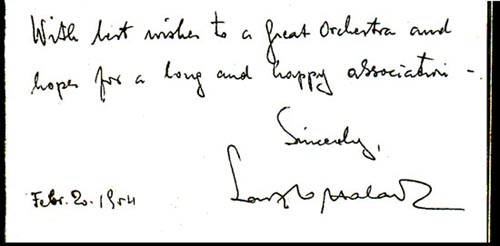
After the first sessions have resulted in satisfactory recordings,
Laszlo Halasz - like so many other artists and conductors - signs
Heinrich Köhler's scrapbook.
 |
|
With
best wishes to a great orchestra and hope for a long and happy
association - Sincerely, Laszlo Halasz, Febr. 20. 1954.
|
The
date Halasz writes is February 20, but it is suspected that recording
was already started in the Fall of 1953 as other entries in Köhler's
scrapbook show.
Not well known is conductor Karl Rucht. And the name of André
Gabriel was for a long time surrounded by mistery.
|
|
|
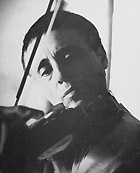
Tossy
Spivakovsky plays Glazunov?
(Photo Everest)
|
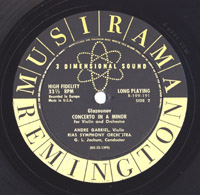
Label
and cover of the disk with Glazunov's Violin Concerto mention
André Gabriel as the performing violinist, but the name
cannot be traced and connected to a specific artist. There are
no catalogs that list André Gabriel. The name appears to be
a pseudonym, but for who? For violinist Janine Andrade
- who later made a recording in Germany with conductor Hans
Jürgen Walter of the Tchaikovsky Concerto Op. 35 and also of
Mozart Concertos with Kurt Masur? Or maybe Gerhard Taschner?
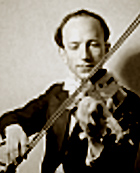
Or Rudolf Schulz, first violinist (leader) of the RIAS
Symphony who may be the violinist in the Remington Swan Lake
and Carnival of Animals recordings with Jonel Perlea and is
of course the violinist in the Fricsay recording of Scheherazade?
But attributing this thoroughbred performance to him would not
be logical. Sure is that the unknown violinist would have been
an artist who did not want his name mentioned because of personal
or legal (contractual) issues.
|
|
|
Rudolf
Schulz plays Glazunov?
|
Remington's
Catalog (Complete Alphabetical Listing By Composer) issued in
the Fall of 1953 could give a hint in this matter. On the last
page it is mentioned that there are plans to make recordings
with Tossy Spivakovsky, with harpsichordist Sylvia Marlowe
and singer Mack Harrell. Recordings with Sylvia Marlowe and
with Mack Harrell were made and released. But a Spivakovsky
disk labelled as such cannot be found. Spivakovsky - who had
come to live in the US (first in New York) in 1940 - may have
been contacted by Recording Director Laszlo Halasz.
Initially
my research did not result in a definite conclusion because
there was no Glazunov Violin Concerto issued on the Bertelsmann
label, nor on the Opera label on which at least Albert Spalding's
Remington Recital with Anthony Kooiker was released in Europe.
And there is also no Glazunov Violin Concerto on the Tefifon
Schallbänder (Sound Film), the medium that bore many of the
Bertelsmann-Remington recordings. No Spivakovsky or Gabriel
(or any other name mentioned above) is printed in the catalogs
of these German firms.
Although
It is plausible that Spivakovsky is the soloist, there is yet
another possibility and that is Bronislaw Gimpel. His style
of playing comes somewhat close to that of André Gabriel.
Yet there are differences.
Years
ago my first guess was Roman Totenberg who toured Europe
at the time the RIAS recordings were made. Muza and Heliodor
recordings were proof of his traveling through Europe. Heinrich
Köhler's scrapbook was signed in 1954 by both Bronislaw
Gimpel and Roman Totenberg as Doris Köhler,
daughter of the cellist, told me. She sent Roman Totenberg's
entry from February 1st, 1954 in Heinrich Köhler's scrapbook.
And Georg Ludwig Jochum did sign the book on the following day.
Seen the differences in execution, I suspected that Totenberg
could be the soloist on R-199-191 which was first released
in the Spring of 1955.

Mr.
Heinrich Köhler with best wishes and many regards, Roman
Totenberg, Berlin, 1 February, 1954
Herrn Heinrich Köhler, mit besten Wünschen
und vielen Grüssen, Roman Totenberg, Berlin, 1 Feb 1954
|
|
|
The
first pressings (ED 1) of the Concerto have a black-gold
label like similar to all earliest MUSIRAMA recordings.
The later pressings had red and even blue labels..
|
The
Remington disc contains a wonderful and also fascinating performance.
It is not a dragging account with too many phrases played legato
as if most of the concerto has to be executed in one endless
stroke as some recordings evoke. The Remington performance has
a wonderful dramatic concept and architecture with depth and
detail. The result clearly shows a thourough understanding of
the work, not only by the virtuoso violinist but also by the
very able conductor Georg Ludwig Jochum. His structured
rendering of the score is in contrast to the somewhat less firm
approach of Ferenc Fricsay with Erica Morini and that while
Morini's Bruch with Fricsay on the same Deutsche Grammophon
disc - later reissued on Heliodor - is full of passion, is like
fireworks. Vaclav Smetacek's rendition with Ida Haendel is also
less than Totenberg's performance. The Glazunov Concerto is
not a standard and for a recording most violinists have to study
the score more intensely or even for the first time. Michael
Rabin's recorded performance, announced at the time and released
in October, 1955, (in Great Britain on Columbia 33cx1281 and
in the USA on Angel 35359) to which the Totenberg had to compete,
is not at Totenberg's level either. Totenberg is also in contrast
with the lyricism of Nathan Milstein and William Steinberg,
or Milstein in his later recording with Rafael Frühbeck
de Burgos. Like Steinberg, Georg Ludwig Jochum understands very
well the orchestral part though Jochum is more strict, better
organized. And Roman Totenberg knows how to re-create the score
in a very expressive and at times humble, yet effective way.
Totenberg's cadenza proofs that he knows his Bach also very
well. This is the old - but magnificent - school talking to
the listener. - R.A.B.
|
 |
Click
here
for a Sound Clip of Cadenza and the beginning of the Third Movement
of the Glazunov Violin Concerto
|
|
 On
January 9, 2012, Allan Evans of
Arbiter
Records, who interviewed Roman Totenberg extensively
and prepared the 2 CD set "The Art of Roman Totenberg
from Bach to Webern", confirmed that the Remington
recording is indeed of Roman Totenberg. He wrote:
On
January 9, 2012, Allan Evans of
Arbiter
Records, who interviewed Roman Totenberg extensively
and prepared the 2 CD set "The Art of Roman Totenberg
from Bach to Webern", confirmed that the Remington
recording is indeed of Roman Totenberg. He wrote:
"Totenberg laughs about how he had to coin this pseudonym
in order to have an extra recording out. He was an Allegro artist
then, and couldn't have his name on Remington. The original
tape is with German radio (...)".
This
explains why the sound has the typical characeristisc of Frequency
Modulation Radio (FM) which differs substantially from the other
Musirama recordings made with the RIAS Orchestra. As early as
1950 FM radio was in use. The sound characteristic means that
this recording was not done by the Remington-Bertelsmann team,
although Laszlo Halasz may have attended this Radio In American
Sector recording as well. It is not a live recording. - R.A.B.
Roman
Totenberg who was born on January 1,1911, in Lodz, Poland, passed
away on May 8, 2012.
|
The
Remington recordings with the RIAS Symphony are all in the new MUSIRAMA
presentation except for one which is not presented as such and that
is the new recording of Rimsky-Korsakoff's Scheherazade. On
Remington R-199-11 originally an early recording of the Viennese Symphonic
Society Orchestra conducted by
H. Arthur Brown
(founder of the Tulsa Philharmonic Orchestra and conductor from 1948
till 1958) is released. When problems arise between Brown and the
union, Gabor stops the pressings of Brown's Remington recordings and
some of these are shifted to the Plymouth label. Now it is time to
acquire a new Scheherazade recording as no record label can do without
this best selling score. The new recording is the one with the RIAS
Symphony Orchestra under Karl Rucht.
For
a long time it was not certain if this recording was the same as the
Urania 7133 (=Urania 7-19) recording with 'Symphony Orchestra of Radio
Berlin'. This recording was already listed in 'The Long Player' of
December 1953 while the Remington with the RIAS Orchestra under Rucht
was released in the following year. Ernst Lumpe who investigates
many recordings bootlegged by Eli Oberstein and released on
Allegro-Royale,
compared the Urania Scheherazade to the Remington RIAS and
found that these are different recordings.
Apparently
to keep the appealing Steinweiss cover as it originally was used for
the recording with H. Arthur Brown, no MUSIRAMA emblem was printed
on it in the right lower corner as this would have spoiled it. Also
the label does not have the MUSIRAMA lettering.
Rucht and the RIAS Symphony give a far better rendition than H. Arthur
Brown does with the orchestra from Vienna - not only because the RIAS
seems a superior orchestra, but also because Brown takes tempi far
too slow and it seems that he does not completely understand what
the music is about. It is likely to assume that the violinist in the
Rucht Scheherazade is Rudolf Schulz. When the Rucht version
was later released on Masterseal MSLP 5012 for conductor the
name of Kurt Wöss is mentioned instead of Karl Rucht.
The
change of the name is probably made because the contract that stipulates
that the recordings are for release by Remington in the USA and that
Bertelsmann owns the rights for Germany (even though the Bertelsmann
Schallplattenring division was only founded in 1956). Obviously
the contract had been breached by Gabor when he issued recordings
on the Diamant label in Germany. A later re-release with the name
Rucht was unlawful and could have had consequences if discovered.
Karl
Rucht
 Initially
I only found Karl Rucht listed in early editions of Schwann
Long Playing Record Catalog conducting Scheherazade on Urania.
In a French catalog he was listed on Concerteum CT 263/4
(later issued on Musidisc 842/843) conducting Bach's Brandenburg
Concertos played by the Berlin Chamber Orchestra. There is also
Urania 7146 (Request Series) with Polovetsian Dances from Prince
Igor, and Urania 7149 with Mendelssohn: Piano Concerto No. 1
performed by pianist Helmut Roloff (coupled with Beethoven's
Piano Concerto No. 1 in C Op. 15 with eminent Beethoven pianist
Hugo Steurer and conductor Gerhard Pflueger).
And there are also Remington R-199-218 with Liszt and Brahms,
and a Masterseal release with excerpts from Gayaneh by Khatchaturian.
Heinrich Köhler, first cellist in the RIAS Orchestra told
me that Karl Rucht was a trumpeter in the Berlin Philharmonic
who started to take up conducting. Initially
I only found Karl Rucht listed in early editions of Schwann
Long Playing Record Catalog conducting Scheherazade on Urania.
In a French catalog he was listed on Concerteum CT 263/4
(later issued on Musidisc 842/843) conducting Bach's Brandenburg
Concertos played by the Berlin Chamber Orchestra. There is also
Urania 7146 (Request Series) with Polovetsian Dances from Prince
Igor, and Urania 7149 with Mendelssohn: Piano Concerto No. 1
performed by pianist Helmut Roloff (coupled with Beethoven's
Piano Concerto No. 1 in C Op. 15 with eminent Beethoven pianist
Hugo Steurer and conductor Gerhard Pflueger).
And there are also Remington R-199-218 with Liszt and Brahms,
and a Masterseal release with excerpts from Gayaneh by Khatchaturian.
Heinrich Köhler, first cellist in the RIAS Orchestra told
me that Karl Rucht was a trumpeter in the Berlin Philharmonic
who started to take up conducting.
|
|
|
Conductor
Karl Rucht
(Image taken from Berlin Philharmonic catalogue of concerts.
Image supplied by Ernst A. Lumpe.)
|
The Scheherazade on the Remington Musirama edition not only
shows excellent ensemble playing but also a good recording technique
(which applies to all MUSIRAMA recordings made in Berlin). Not
just for Remington standards but it is in principle also
superior if compared to the recording technique used by Deutsche
Grammophon at the time. A later recording was of the Hungarian
Rhapsodies (Liszt) and Hungarian Dances (Brahms) on R-199-218.

Karl
Rucht (trumpet) in Brandenburg Concerto No. 3 (Bach) with Erwin
Milzkott (flute) and Max Michailoff (hobo). Conductor of the Chamber
Orchestra of Radio Berlin is Herbert Haarth. Concerteum CT 263.
In the USA Period SHO 310.
Recently
more data regarding Karl Rucht have been published and it appears
that Karl Rucht (1918-1994) was more than the trumpet player
in the Berlin Philharmonic Orchestra from 1944 till 1949. He
was chief conductor of the Philharmonic Orchestra of the Pfalz
(Philharmonisches Orchester der Pfalz) in Mannheim (later renamed
Deutsche  Staatsphilharmonie
Rheinland-Pfalz) from the beginning of season 1951/1952. He
was conductor of the Heidelberg Philharmonic Orchestra (Philharmonisches
Orchester der Stadt Heidelberg) from 1954 until 1960. This means
that he led two orchestras simultaneously from 1954 till 1957.
Being the conductor of these two orchestras in the same region
made it possible to perform large orchestral works by "borrowing"
musicians from either orchestra. - R.A.B. Staatsphilharmonie
Rheinland-Pfalz) from the beginning of season 1951/1952. He
was conductor of the Heidelberg Philharmonic Orchestra (Philharmonisches
Orchester der Stadt Heidelberg) from 1954 until 1960. This means
that he led two orchestras simultaneously from 1954 till 1957.
Being the conductor of these two orchestras in the same region
made it possible to perform large orchestral works by "borrowing"
musicians from either orchestra. - R.A.B.
|
The
virtuoso quality and discipline of the RIAS Orchestra can also be
witnessed on many other Remingtons, but in particular the Jonel Perlea
disc with excerpts from Swan Lake (Tchaikovsky) and Le carnaval des
animaux (Saint-Saëns) in which Heinrich Köhler plays
the cello part (The Swan/Le cygne).
Georges Sebastian's 'Symphony fantastique' (Berlioz) is also a very
skillful and sensitive performance. And the recordings by Edward Kilenyi
of works by Liszt do have the right intensity and the perfect balance
between soloist and orchestra.
However, in the first notes of the Glazunov Violin Concerto played
by André Gabriel which was issued by Remington, there is some
wow in the recorded sound. It is possible that the tape did not reach
the correct speed when the recording was tranferred to the tape that
was sent to the Remington headquarters in New York. Or the tape had
not reached the nominal speed yet when the lacquer was cut.
CHOOSE ANOTHER SUBJECT
Catalog
Recordings
made with the RIAS Symphony Orchestra and released on the Remington
MUSIRAMA label:
R-199-11 Scheherazade (Rimsky-Korsakov) - Karl Rucht, conductor.
R-199-159 La boîte à joujoux - The Box of Toys
(Debussy) - Jonel Perlea, conductor.
R-199-160 Carnival of Animals - Carnaval des animaux (Saint-Saëns))
and Excerpts from Swan Lake (Tchaikovsky) - Jonel Perlea, conductor.
It
is not known who the pianists are in Carnival of Animals on
R-199-160. The Saint-Saëns recording with Jonel Perlea conducting
was not issued on Tefifon or Bertelsmann. These companies had
already a different recording with pianists Sondra Bianca and
Herbert Drechsel with the 'Hamburger Bach Orchestra' conducted
by Robert Stehli.
|
|
|
Click here
for a Sound Clip of 'Le cygne' (The Swann) from 'Carnival of Animals'
performed by cellist Heinrich Köhler.
|
|
|
|
|
With
the highest admiration for the very excellent Rias orchestra,
Jonel Perlea, August 27, 1953
Mit höchster Bewunderung für das ganz vorzügliche
Rias Orchester, Jonel Perlea, 27. August 1953
|
.
R-199-164 Piano Concerto No. 2 (Brahms) - Edward
Kilenyi, pianist andJonel Perlea, conductor.
R-199-166 Piano Concerto No. 1 and Totentanz
(Liszt) -
Edward
Kilenyi, pianist and Jonel Perlea, conductor.
R-199-170 Orchestral medleys from The Merry Widow
(Lehar) and One Night in Venice (Strauss) - Gerhard Becker who was
in his early thirties then was the conductor. Gerhard Becker (1919–1973)
was also a composer and arranger in the lighter trade. He composed
music for tv-series and movies and made several recordings in the
nineteen sixties as well. One of these is ofFranz Lehar's operetta
Paganini with soloists and the Fürsten Feldbruck
Orchestra and the RIAS Chamber Choir, and Max Kayser playing "Paganini's
violin".
R-199-172 Gaité parisienne (Offenbach) - Manuel Rosenthal,
conductor. Later released in a new disguise as R-199-254. The same
recording was issued on Rondolette A8 around 1958. Were the tapes
acquired via Don Gabor? Or was Rondolette another of Don Gabor's labels
or (partly) owned by him?
R-199-174 Orchestral excerpts from Wagner operas
-
George Sebastian,
conductor.
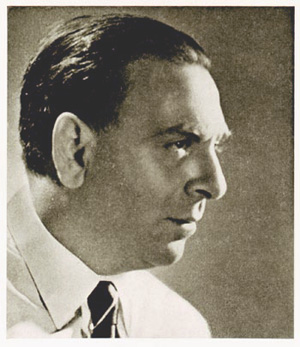
Picture
of George Sebastian taken from an advertisement for Remington MUSIRAMA
releases.
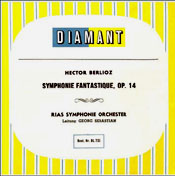
R-199-176 Symphonie Fantastique (Berlioz) - George Sebastian,
conductor. In Germany released on the Diamant label, reference
BL 733. The recording was probably made in the Fall of 1953.
|
|
|
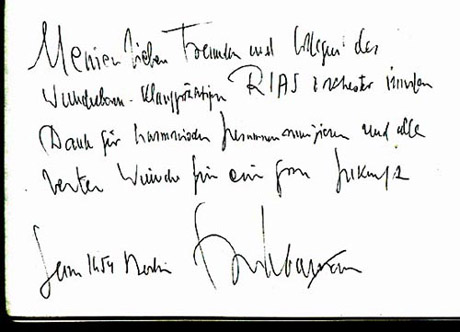
To
my good friends and colleagues of the wunderful, magnificently
sounding RIAS orchestra. My thanks for making harmonious music
together and all best wishes for a great future. January, 1954,
Berlin. Georges Sebastian.
Meinen lieben Freunden und Kollegen des
wunderbaren klanggrossartigen RIAS Orchester (...). Dank für
harmonischem Zusammen Musizieren und alle besten Wünsche
für eine grosse Zukunft. Januar, 1954, Berlin. Georges Sebastian.
|
|
|
|
To
my dear RIAS Orchestra - with sincere thanks for professional
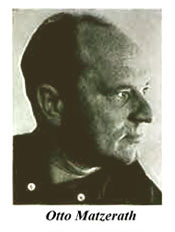
music making. November/January 1953/54. Otto Matzerath.
Meinem lieben Rias Orchester - mit herzlichen
Dank für professionelles Musizieren. November/Januar 1953/54.
Otto Matzerath.
|
R-199-177 Wagnerian Overtures - Leopold Ludwig, conductor.
R-199-180 Symphony No. 1 (Schumann) - Otto Matzerath,
conductor - released Spring 1955
R-199-181 Light French Opera Overtures: Von Suppé,
Adam, Aubert, Maillart - Gerhard Becker, conductor.
R-199-183 Music by Offenbach "Offenbachiana" arranged
and conducted by Manuel Rosenthal.
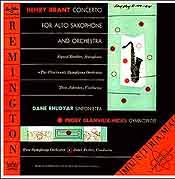
 R-199-188
Sinfonietta (Rudhyar), Gymnopedia (Glanville-Hicks) -
Jonel Perlea,
conductor (coupled with Henry Brant's Saxophone Concerto performed
by Sigurd Rascher (saxophonist of the New York Philharmonic)
here with the Cincinnati Symphony conducted by Thor Johnson) - released
Fall 1955 R-199-188
Sinfonietta (Rudhyar), Gymnopedia (Glanville-Hicks) -
Jonel Perlea,
conductor (coupled with Henry Brant's Saxophone Concerto performed
by Sigurd Rascher (saxophonist of the New York Philharmonic)
here with the Cincinnati Symphony conducted by Thor Johnson) - released
Fall 1955
R-199-189 Can Can (Offenbach) - Manuel Rosenthal, conductor
(coupled with selections from the musical Can Can played by Tony Osborne
and his orchestra).
R-199-191 Violin Concerto (Glazunov) - André
Gabriel, violin and Georg Ludwig Jochum, conductor.
This was a radio recording probably
made in February, 1954, when Georg Ludwig Jochum signed the scrapbook
of cellist Heinrich Köhler. The Violin Concerto was coupled
with The Origin of Fire (Sibelius) with the
Helsinki University Chorus
and soloist Sulus Saarits, baritone, and Pohjola’s Daughter,
Op. 49 (Sibelius).
|
|
|
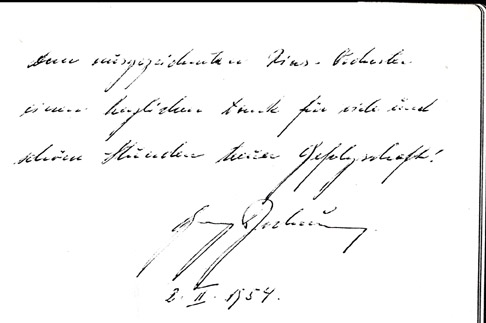
A
heartily thank you to the outstanding RIAS Orchestra for many
and fine hours of faithfull following. Georg Ludwig Jochum.
February 2nd, 1954
Dem augezeichneten RIAS-Orchester einen
herzlichen Dank für viele und schöne Stunden treuer
Gefolgschaft. Georg Ludwig Jochum. 2. Februar 1954.
|
|
|
|
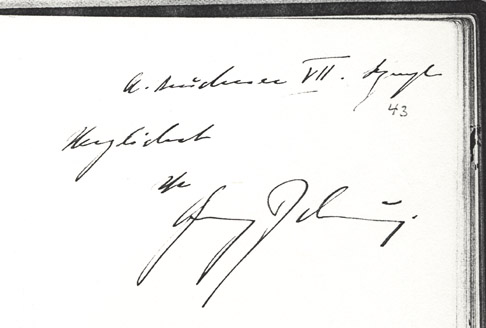
And
he signed after conducting Symphony No. 7 of Anton Bruckner.
A. Bruckners VII. Symph. Herzlichst Ihr
Georg Ludwig Jochum.
A. Bruckner's 7th Symphony. Heartily Yours Georg Ludwig Jochum.
The date is not mentioned.
|
 R-199-192
Orchestral medley from The Beggar Student (Millöcker) - Gerhard
Becker, conductor. R-199-192
Orchestral medley from The Beggar Student (Millöcker) - Gerhard
Becker, conductor.
R-199-194 Brandenburg Concerto No. 4 (Bach), Concerto Grosso
No. 5 (Handel) -
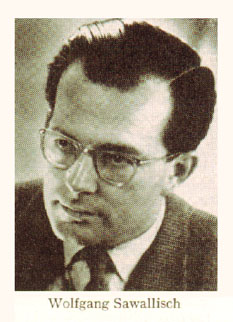
Wolfgang Sawallisch,
conductor.
R-199-197 Piano Concerto No. 1 (Tchaikovsky) -
Conrad Hansen,
pianist and Wolfgang Sawallisch, conductor.
R-199-201 Symphony No. 5 (Sibelius) - Jussi Jalas,
conductor.
R-199-203 Francesca da Rimini (Tchaikovsky) and Theme and
Variations (Tchaikovsky) - Anatole Fistoulari, conductor.
|
|
|
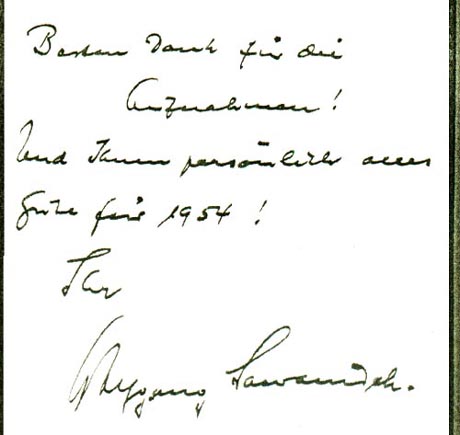
All
my thanks for the recordings! And You personally all the best
for 1954! Yours Wolfgang Sawallisch.
Besten Dank für die Aufnahmen! Und
Ihnen persönlich alles Gute für 1954! Ihr Wolfgang Sawallisch.
|
|
|
|
Heitor
Villa-Lobos conducting.
|
|
|
|
Jussi
Jalas recorded works of his father in law Jean Sibelius: Symphonies
Nos. 1, 2 and 5 and Five humoresques for violin solo and orchestra
with violinist Anja Ignatius. Only Symphony No. 5 was released
on Remington.
|
|
|
|
Leopold
Ludwig
|
R-199-205 Variations on a Theme by Haydn (Brahms) - Wolfgang
Sawallisch conducting. Coupled with Tragic Overture (Brahms), Academic
Festival Overture (Brahms) with conductor Otto Matzerath.
R-199-207 Choros No. 6 (Villa-Lobos) - conducted by Villa-Lobos
himself, coupled with the older recordings of Enesco's Rumanian Rhapsodies
Nos. 1 and 2, conducted by Enesco. The coupling probably in remembrance
of George Enesco who died in 1955.
R-199-208 Suites from Sylvia and Coppélia (Delibes)
- Anatole Fistoulari and George Sebastian, conductors.
In 1967 these performances were reissued in 1967 on Everest 6116 (mono)
and 3116 (stereo). This indicates that the recordings were made in
stereo, though not on 35 mm film which most certainly was not used
for the dubbing of the tape either. The Everest release not only shows
that the sound of these recordings was basically excellent for those
days standard, but also the performances are noteworthy.
R-199-218 Hungarian Rhapsody No. 2 and No.14 (Liszt), Hungarian
Dances No. 1 through 6 (Brahms) with Karl Rucht conducting;
the same program of rhapsodies and dances was later re-released on
the Paris-label (Album 12) and pressed on better vinyl. Although
I saw the cover of 199-218 once, various Schwann catalogs, the 1956
Artist Listing and the Artist Issue of 1958 included, do not have
this recording listed. It may have had a very short life span as a
Remington release, because after the last releases starting at 200,
the label soon was suspended and the recordings were released on Gabor's
other labels like Paris, Buckingham and Webster and were not listed
any longer in the serious record catalogs: Schwann and The Longplayer
as they were now sold in convenient stores and gaz stations.
 In
cooperation with Bertelsmann recordings were also made with the Hamburg
Philharmonic Orchestra (Remington R-199-209) with works by
Hindemith (Mathis der Mahler), Schumann (Manfred Overture), and Von
Weber (Euryanthe Overture), all conducted by Leopold Ludwig. In
cooperation with Bertelsmann recordings were also made with the Hamburg
Philharmonic Orchestra (Remington R-199-209) with works by
Hindemith (Mathis der Mahler), Schumann (Manfred Overture), and Von
Weber (Euryanthe Overture), all conducted by Leopold Ludwig.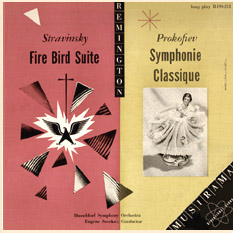
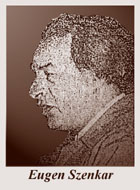
And with the Dusseldorf Philharmonic Orchestra and conductor Eugen
Szenkar (1891-1977) released on Remington R-199-212, with
works by Igor Stavinsky (Firebird Suite) and Sergei Prokofiev (Classical
Symphony). These were also listed in the Tefifon catalog.
CHOOSE ANOTHER SUBJECT
Tefifon
|
Tefi Schallbänder - Tefi Sound Films.
Many
of the recordings made with the RIAS Orchestra are listed in
the catalog of the Tefi Schallbänder (Tefi Sound Films).
Tefi Sound Films were to be played on the Tefifon and other
special Tefi reproducers (Tefi Geräte).
The Tefi Schallband was an alternative to the gramophone record,
the wire recorder, tape recorder and the
Philips
Miller Sound Recording System.
The
Tefifon was invented by Dr. Karl Daniel (1905-1977).
The sound was engraved on an endless film and was originally
read by a crystal (seignette's salt) cartridge and after about
1960, by a ceramic (barium titanatecrystal) pick up cartridge.
Moving Magnet cartridges were never incorporated in the designs,
although hobbyists and researchers use MM cartridges with special
needles to listen to the tapes and above all to transfer the
music to digital formats as Klaus Holzapfel from Germany does.
The principle of this system of sound recording had been devised
by Oberlin Smith, the man who also had the idea for magnetic
recording in 1889.
Tefi
cassettes were available from 1950 until 1962. A great advantage
of the system was that it was really a long play medium
as one Tefi Schallband (sound tape) could easily have one hour
of music at a speed of 19 cm/s. And it was also suitable for
stereo. When stereo was introduced the ceramic cartridge
was replaced by a better phono cartridge which then read the
endless groove (loop). How it works is shown in this video by
 Techmoan
on YouTube.
Techmoan
on YouTube.
|
|
|
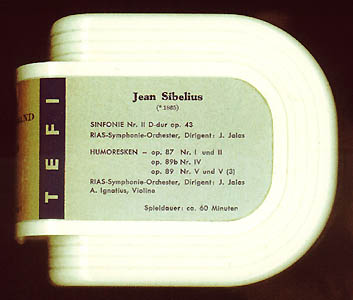
The
Tefifon Schallband with the Second Symphony and Five Humoresques
of Jean Sibelius, conducted by Jussi Jalas, with violinist
Anja Ignatius as issued in Germany. The
recording of the Five Humoresques was in fact the world
premiere recording and was never issued by Don Gabor though
he and Laszlo Halasz supervised these recordings in Berlin.
J. Radnuz was the recording engineer.
(The
above image of the Tefifon cassette and information
on the Tefifon Schallbänder were submitted by Dr.
Klaus Holzapfel from Germany.)
|
|
|
Only
the recording of the 5th Symphony of Jean Sibelius was
issued in the MUSIRAMA Series. The recording of the Symphony
No. 1 was released together with Five Humoresques on
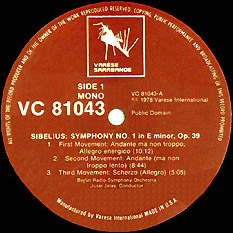
Varèse Sarabande VC
81043 in 1978. Varèse-Sarabande mentions 'Radio
Symphony Orchestra' instead of the RIAS Symphony. This
is incorrect as the recordings were made in January of
1954 and the RIAS orchestra was renamed Radio Symphony
Orchestra (RSO) only in 1956.
|
The
Tefi Schallbänder catalog (Tefifon Schallband Katalog)
shows several of the titles which also appeared on Remington:
Edward Kilenyi playing Franz Liszt's Concerto No. 1 and
Brahms's No. 2 with Jonel Perlea, Conrad Hansen playing
Tchaikovsky's Op.23 with Wolfgang Sawallisch, and Karl Rucht
conducting Scheherazade, Hungarian Rhapsodies and Gayaneh, and
Anatole Fistoulari conducting Tchaikovsky's Francesca
da Rimini.
A
few titles with Tefi references:
TA/K
4012 Millöcker Beggar Student - Gerhard Becker
TD/K 4029 Strauss One Night In Venice - Gerhard Becker
TD/S 4082 Bach and Handel - Wolfgang Sawallisch
TD/S 4083 Tchaikovsky Swan Lake - Jonel Perlea
TD/S 4084 Liszt Concerto and Todtentanz - Edward Kilenyi and
Jonel Perlea
TD/S 4085 Rimsky-Korsakov Scheherazade - Karl Rucht
TD/S 4086 Sibelius Symphony No. 2 and Humoresques - Jussi Jalas
TD/S 4090 Tchaikovsky Concerto No. 1 - Conrad Hansen and Wolfgang
Sawallisch
TD/S 4093 Beethoven Symphony No. 1 and Symphony No. 2 - Jonel
Perlea and Georg Ludwig Jochum
TD/S 4094 Brahms Piano Concerto Mo. 2 - Edward Kilenyi and Jonel
Perlea
|
CHOOSE ANOTHER SUBJECT
Bertelsmann
The collaboration with the Bertelsmann Company in Germany officially
started in 1953 and some 200 recordings were planned to be made in
the new MUSIRAMA-technique with the RIAS Symphony Orchestra. In Germany
they were of course released on Bertelsmann's Phonoring or Schallplattenring
as well as on the Tefifon tapes. Don Gabor wanted to release the older
recordings from Austria and several American recordings in Germany
too. For that he created the German Diamant label already in
1953 right after the Bertelsmann deal had been signed.
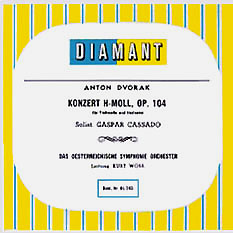 The
Diamant releases are pressed from Remington plates, probably
in the Webster plant in Massachusetts, although there is mention in
Billboard magazine that Gabor was setting up a pressing plant in Berlin.
The dead wax shows a different font. From the way the covers are printed
and manufactured, I assume that the covers are made in the printing
division of Remington's Webster pressing plant as well because that
would be cheaper than having them manufactured in Germany. On the
label is printed "Licensed by Remington Records." The German covers
had no liner notes. There was probably no time to write these, or
a correct translation of the American notes would take up time and
would make the releases more expensive. All covers have a standard
pattern of yellow-light and blue-white colored stripes. On the front
are printed the name of the composer, of the work(s) and the names
of the performers, and there is a reference number for ordering the
record, in German, "Best. Nr." (Bestell Nummer). The
Diamant releases are pressed from Remington plates, probably
in the Webster plant in Massachusetts, although there is mention in
Billboard magazine that Gabor was setting up a pressing plant in Berlin.
The dead wax shows a different font. From the way the covers are printed
and manufactured, I assume that the covers are made in the printing
division of Remington's Webster pressing plant as well because that
would be cheaper than having them manufactured in Germany. On the
label is printed "Licensed by Remington Records." The German covers
had no liner notes. There was probably no time to write these, or
a correct translation of the American notes would take up time and
would make the releases more expensive. All covers have a standard
pattern of yellow-light and blue-white colored stripes. On the front
are printed the name of the composer, of the work(s) and the names
of the performers, and there is a reference number for ordering the
record, in German, "Best. Nr." (Bestell Nummer).
On
the Diamant label appear older recordings made in Vienna like
Franck's Symphony in D conducted by Hans Wolf (BL 743), Astrid
Varnay singing Wagner arias (BL 737) and Gaspar Cassado
performing Dvorak's Cello Concerto with conductor Kurt Wöss
(BL 745). This is all as planned.
But also Symphony Fantastique (Berlioz) with the RIAS Orchestra under
Georges Sebastian in the new Musirama sound is released as
BL 733 while this recording is also released by Bertelsmann and on
the Tefifon Band (celluloid tape). Distributing the Diamant releases
in Germany is of course against the terms agreed upon between Gabor
and the Bertelsmann firm. Cellist Heinrich Köhler told me that
there was a law suit: Bertelsmann v. Remington (Don Gabor).
The outcome was that the contract with the RIAS Orchestra and Bertelsmann
was prematurely ended. That is why many more recordings made with
the RIAS Symphony are not issued in the US. Also the later stereo
recordings were excluded.
The
breach of contract with Bertelsmann prevented the release on
Remington of many more recordings made with the RIAS Symphonie-Orchester
which were released in Germany on Tefi casettes (Tefifon Schallbänder).
If the cooperation had evolved satisfactorily, also recordings
with other orchestras could have been made. The Tefifon recordings
that were missed because they were never issued on Remington:
*Adam:
If I were King - Gerhard Becker
*Auber: Fra diavolo - Gerhard Becker
*Beethoven: Symphony No. 2 - Georg Ludwig Jochum
*Berlioz: Ballet Music - Wolfgang Sawallisch
*Bizet: Sylvia - Anatole Fistoulari
*Borodin: In the Steppes of Central Asia - Anatole Fistoulari
*Delibes: Coppelia - George Sebastian
*Glinka: A Life for The Tsar Overture - Anatole Fistoulari
*Glinka: Ruslan and Ludmilla Overture - Otto Matzerath
*Glinka: Waltz Fantasy - Anatole Fistoulari
*Gounod: Ballet Music from Margarethe - Wolfgang Sawallisch
*Mendelssohn-Bartholdy: Symphony No. 4 - Otto Matzerath
*Ponchielli: Dance of the Hours - Wolfgang Sawallisch
 *Rimski-Korsakov:
Russian Easter Overture - George Sebastian *Rimski-Korsakov:
Russian Easter Overture - George Sebastian
*Saint-Saëns: Danse macabre - George Sebastian
*Saint-Saëns: Bacchanale from Samson and Delilah - George
Sebastian
*Schubert: Symphony No. 2 - Otto Matzerath (recorded
on February 19, 1954, according to another entry by Laszlo Halasz
in Heinrich Köhler's scrapbook).
*Schubert: Rosamunde Overture - Otto Matzerath
*Sibelius: Symphony No. 1 - Jussi Jalas
*Sibelius: Five Humoresques- Jussi Jalas (and violinist
Anja Ignatius)
*Sibelius: Symphony No. 2 - Jussi Jalas
|


Above is the entry in the Tefifon catalog of
the One Hour Tape (Tefi-Stunden-Band) with the 2nd Symphony
of Jean Sibelius played by the RIAS Symphony Orchestra conducted
by Jussi Jalas and the Five Humoresques played by violinist
Anja Ignatius.
|
*Strauss: Don Juan - Otto Matzerath
*Strauss: Til Eulenspiegel's Merry Pranks - Otto Matzerath
*Tchaikovsky: Capriccio Italien - Anatole Fistoulari
*Tchaikovsky: Marche Slave (Slavomic March) - Karl Rucht
*Tchaikovsky: Serenade for Strings - H. Charlier
*Weber: Invitation to the Dance - Otto Matzerath
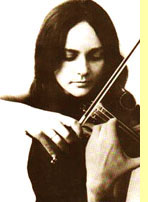 Arrangements
could probably also have been made for the release on Remington
of the 2nd Violin Concerto of J.S. Bach played by then 23 year
old violinist Helga Hussels who later (1969) was refused to
be a member of Herbert von Karajan's Berliner Philharmoniker
(Berlin Philharmonic Orchestra). She could have been the first
woman in that famous sound body (Klangkörper) but conductor,
management and members wanted to keep the Berliner
Philharmoniker
strictly a men's affair. That was a weird experience, to say
the least, she told me when I had contacted her in early January,
2012. She sent me a photograph of her sitting on a motorbike
that looked like a Harley Davidson. The former owner of her
house had left it in the barn. In return I sent her an MP3 of
Fou Ts'ong playing Chopin's Mazurka dedicated to Emile Gaillard.
She thought it was wonderful. Arrangements
could probably also have been made for the release on Remington
of the 2nd Violin Concerto of J.S. Bach played by then 23 year
old violinist Helga Hussels who later (1969) was refused to
be a member of Herbert von Karajan's Berliner Philharmoniker
(Berlin Philharmonic Orchestra). She could have been the first
woman in that famous sound body (Klangkörper) but conductor,
management and members wanted to keep the Berliner
Philharmoniker
strictly a men's affair. That was a weird experience, to say
the least, she told me when I had contacted her in early January,
2012. She sent me a photograph of her sitting on a motorbike
that looked like a Harley Davidson. The former owner of her
house had left it in the barn. In return I sent her an MP3 of
Fou Ts'ong playing Chopin's Mazurka dedicated to Emile Gaillard.
She thought it was wonderful.
After the Berlin Philharmoniker affair she went to live in Sweden
and made a career as a soloist and as a member of the Symphony
Orchestra of Göteborg (Göteborgs Symfoniker) and Göteborgs
Sinfonietta.
When she played Bach, the RIAS Youth Orchestra was conducted
by Willy Hanuschke. That performance was released on Bertelsmann
LP 338089, coupled with Brandenburg Concerto No. 4 performed
by the RIAS Symphony Orchestra conducted by Wolfgang Sawallisch.
That recording could have been released on Remington. Could
have. -
Helga Gmelin-Hussels, 15 January, 1930 - 28 May, 2018
In
the Tefifon catalog the youth orchestra is just mentioned as
RIAS Symphony Orchestra. Conductor Hanuschke recorded also Georg
Philip 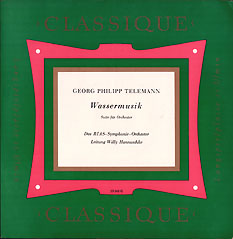 Telemann's
Wassermusik which was released later on Classique 13 160G (10"). Telemann's
Wassermusik which was released later on Classique 13 160G (10").
And there is also no Remington disc of Beethoven's Symphony
No. 1 with Jonel Perlea conducting the Teatro la Fenice
which was released in Germany on a Tefi cassette. This recording
- which should replace the Remington disc recorded in Vienna
with "conductor X" - was made at the time when Lucia
di Lammermoor and music of American composers Brant, Glanville-Hicks,
etc. was recorded. The vaults of BMG and the Berlin Radio could
reveal many a historical treasure. - R.A.B.
|
It is likely that several tapes with these recordings - which were
practically all supervised by Laszlo Halasz (in many cases together
with Don Gabor) were taken back to the US or were shipped to Don Gabor's
headquarters in New York but were not issued on record after the verdict
of the court. They probably were not discovered by Tom Null when he
was producing the Remington Series for the Varèse-Sarabande
label, or - if he found them - were all in a bad shape and could not
be used.
As
is printed on many a cover of the
Varèse-Sarabande Remington Series,
most recordings were supervised by both Don Gabor and Laszlo Halasz,
and the recording technician was J. Radnuz. Tape recorders with 30
IPS speed were in use to obtain high quality.
It
is not sure if the orchestra was also conducted by Laszlo Halasz.
The release of Bertelsmann Schallplattenring 8135 indicates
that Laszlo Halasz conducted the RIAS Symphony in Hungarian Dance
No. 6, which is of course one of the dances conducted by Karl Rucht.
This same Bertelsmann disc has excerpts from recordings made by other
Remington artists: Wolfgang Sawallisch, Alexander Jenner and Karl
Rucht. It is possible that Halasz did conduct the Hungarian Dance
and that his name was deliberately changed into that of Karl Rucht
or the opposite may have been the case.
An
oddity is the recording with Karl Rucht conducting Gayaneh by Khachaturian
on a Masterseal release with the Remington Musirama label and
Remington matrix numbers which were printed also on the label: 33
1637. I did not find a Remington Musirama equivalent. Columbia
Records had won the case against Don Gabor, and the latter was no
longer allowed to use the wording Masterworks and the label name "Masterseal"
- which easily could be confounded with Columbia's Masterworks - was
prohibited as well. Subsequently many records were released with the
Remington style labels and the word Masterseal was erased from the
covers.
On Webster ST12 Tchaikovsky's Swan Lake Suite with Jonel Perlea
from R-199-160 is reissued together with Otto Matzerath's performances
of Academic Festival Overture and Tragic Overture (Brahms) which were
originally on Remington R-199-205.
When
Bertelsmann a few years later founded the Ariola Division,
many of the recordings were released on their Classique label.
To mention a few:
13174H - Tchaikovsky: Piano Concerto No. 1 with pianist
Conrad Hansen and conductor Wolfgang Sawallisch.
16 087D - Bach: Brandenburg Concerto No. 3 conducted
by Wolfgang Sawallisch.
13153H - Hindemith: Matthis der Mahler performed by
the Hamburg Philharmonic Orchestra conducted by Leopold Ludwig.
Around the same time 'Harold in Italy' (Berlioz) was recorded but
never reached the Remington catalog though the performance was released
on the Classique label in Germany. It is a beautiful and warm recording
with Micheline Lemoine who plays the alto (viola). Classique 11034S.
CHOOSE ANOTHER SUBJECT
Recordings
of other famous conductors made with the RIAS Symphony Orchestra
From
1953 till 1956 there are many conductors who perform with the RIAS
Symphony Orchestra, especially during this 'period of draught' (when
the orchestra was short of finances): Karl
Böhm, Georg Solti and Otto
Klemperer, Leo Blech, Hermann Abendroth and Eugene
Ormandy. And there were of course the lesser greats. One of
them is Herbert Sandberg who conducts Edvard Grieg's Holberg
Suite on Deutsche Grammophon Gesellschaft LPE 17046.
A
noteworthy event was when the Scala Opera Company visited Berlin
in 1955 and performed with the RIAS Symphonie-Orchester in
Lucia
di Lammermoor conducted by Herbert von Karajan with singers
Maria Meneghini Callas (Soprano), Giuseppe di Stefano (Tenor), Rolando
Panerai (Baritone), Nicola Zaccaria (Bass-Baritone), Giuseppe Zampieri
(Tenor), Luisa Villa (Mezzo-soprano), Mario Carlin (Tenor), The Chorus
of La Scala Milan.
And
there are prominent soloists like pianist Michael Raucheisen.
And there is cellist Enrico Mainardi who performs Cello Concertos
of Haydn and Schumann with Fritz Lehmann conducting (LPM 18
222).
The conductors of the younger generation also swing the baton in front
of the orchestra and Ferenc Fricsay continues to conduct the orchestra
on various occasions, for concerts and for recordings as his discography
shows.
Ferenc
Fricsay

Ferenc
Fricsay (August 9, 1914 -February 20, 1963)
(Photo Copyright Schumacher/Deutsche Grammophon)
See the homepage maintained by Ferenc Fricsay's daughter
Marta Dobay-Fricsay:
Ferenc
Fricsay.
A
page about the RIAS Symphony Orchestra is certainly not complete if
the recordings by the original and eminent conductor Ferenc Fricsay
are not mentioned. He did make numerous recordings with the RIAS Symphony
Orchestra for Deutsche Grammophon. This is his RIAS discography:
Bartok's Violin Concerto with Tibor Varga (18006 LPM),
Bartok's Two Portraits Op. 5 with Violinist Rudolf Schulz (22248 LVM
78 RPM Variable Micrograde, 78 Langspielplatte, 78 rpm long
playing record) - coupled with Paganini Variations by Boris Blacher
(16054 LP), Joseph Haydn's The Clock, Symphony No. 101 (LP 16013),
Bartok's 3rd Piano Concerto with Monique Haas (18223 LPM), his 'Music
for Strings Percussion and Celesta' (LP 16074), and 'Divertimento'
and Dance Suite and Dance Suite (LPM 18153).
|
|
Bartok's
Two Portraits Op. 5 with Violinist Rudolf Schulz (22248 LVM 78
RPM Variable Micrograde (78 UpM Langspielplatte, 78 RPM
long playing record). These were also available on 16 054 LP with
on the other side Boris Blacher's Paganini Variations.
|
Dvorak's 'New World Symphony' (18142 LPM), Stravinsky's
'Le sacre du printemps' (18189 LPM and 'Capricio' with pianist Monique
Haas (18004 LPM), Préludes and Ballet Music from Carmen (17092
LPE), Stravinsky's 'Symphonie des Psaumes' and Frank Martin's 'Petite
Symphonie concertante' (18035 LPM), Tchaikovsky's Fourth Symphony
(18039 LPM), Tchaikovsky's Fifth Symphony (18012 LPM), Werner Egk's
'Kleine Abraxis-Suite' (30228 EPL) and 'Suite française pour
orchestre' (LPM 8401), a program of well-known compositions by Berlioz
(Danse des Sylphes from La damnation de Faust) and Borodin (In the
Steppes of Central Asia), coupled with 'Marche hongroise' performed
with the Berlin Philharmonic, and with the Lamoureux Orchestre (L'orchestre
des concerts Lamoureux): Dukas (L'apprenti sorcier) and Mussorgsky
(A night on Bald Mountain)(19061 LPEM), Stravinsky's 'Petrouchka'
(LPE 17003), Liebermann's 'Furioso' and 'Suite' (30113 EPC), Tchaikovsky's
Serenade for Strings (LPE 17036), Liszt's Hungarian Rhapsodies 1 and
2 (LPE 17055), Mozart's Symphonies Nos. 29 and 41 (18296 LPM), Dvorak's
Violin Concerto with Johanna Martzy (LPM 18152), Haydn's 'The Seasons'
(18025/28 LPM),  Haydn
Symphonies 44 and 95 (18180 LPM) and 98 and 101 (18339 LPM), Rimsky-Korsakov's
Scheherazade (19075 LPEM), Hartmann's Symphony No. 6 (16401 LP), Rossini
Overtures (19041 LPEM), Rossini's 'Stabat Mater' with Maria Stader
and Kodaly's 'Psalmus Hungaricus' with Ernst Haefliger (18203/4 LPM,
released in February 1955; the Deutsche Grammophon CD is not the passionate
RIAS Orchestra performance recorded in mono but a later performance
with slower tempi by Fricsay with the Radio Symphony Orchestra from
a radio broadcast in stereo); Tchaikovsky's 'Overture Solennelle -
1812' Op. 49, with the Don Cossack Chorus/Don Kosaken-Chor, coupled
with Wagner's Overture to 'The Flying Dutchman/Der Fliegende Holländer'
(LPE 17022) - the complete opera with Josef Greindl, Haydn
Symphonies 44 and 95 (18180 LPM) and 98 and 101 (18339 LPM), Rimsky-Korsakov's
Scheherazade (19075 LPEM), Hartmann's Symphony No. 6 (16401 LP), Rossini
Overtures (19041 LPEM), Rossini's 'Stabat Mater' with Maria Stader
and Kodaly's 'Psalmus Hungaricus' with Ernst Haefliger (18203/4 LPM,
released in February 1955; the Deutsche Grammophon CD is not the passionate
RIAS Orchestra performance recorded in mono but a later performance
with slower tempi by Fricsay with the Radio Symphony Orchestra from
a radio broadcast in stereo); Tchaikovsky's 'Overture Solennelle -
1812' Op. 49, with the Don Cossack Chorus/Don Kosaken-Chor, coupled
with Wagner's Overture to 'The Flying Dutchman/Der Fliegende Holländer'
(LPE 17022) - the complete opera with Josef Greindl, 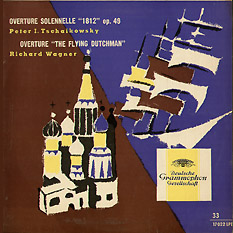 Annelies
Kupper, Wolfgang Windgassen, Sieglinde Wagner, Ernst Haefliger and
Josef Metternich, the RIAS Choir and Orchestra conducted by Ferenc
Fricsay was released on AK (automatische Kupplung = automatic sequence):18063/65
LPM and NK:18116/118 LPM. Then there are Kodaly's Maroszek Dances
and Dances from Galanta (LPE 17060), Respighi's 'La boutique fantasque'
(LP 17054), Mozart's 'The Magic Flute' (LPM 18264/266 NK) and 'Exultate
jubilate' (17027 LPE), Mozart Symphonies 26, 32 and 35 (18066 LPM),
Nos. 41 and 29 (18290 LPM), Verdi's 'Messa da Requiem' with Maria
Stader, Marianne Radev, Helmut Krebs, Kim Borg and the St.Hedwig Cathedral
Choir (18155/56 or 18157/58 LPM), Preludes and Overtures by Verdi
(17015 LPE). Annelies
Kupper, Wolfgang Windgassen, Sieglinde Wagner, Ernst Haefliger and
Josef Metternich, the RIAS Choir and Orchestra conducted by Ferenc
Fricsay was released on AK (automatische Kupplung = automatic sequence):18063/65
LPM and NK:18116/118 LPM. Then there are Kodaly's Maroszek Dances
and Dances from Galanta (LPE 17060), Respighi's 'La boutique fantasque'
(LP 17054), Mozart's 'The Magic Flute' (LPM 18264/266 NK) and 'Exultate
jubilate' (17027 LPE), Mozart Symphonies 26, 32 and 35 (18066 LPM),
Nos. 41 and 29 (18290 LPM), Verdi's 'Messa da Requiem' with Maria
Stader, Marianne Radev, Helmut Krebs, Kim Borg and the St.Hedwig Cathedral
Choir (18155/56 or 18157/58 LPM), Preludes and Overtures by Verdi
(17015 LPE).
|
|
|
|
Zoltan
Kodaly: Maroszek Dances and Dances from Galanta Ference Fricsay
and the RIAS Symphony Orchestra on LPE 17060.
|
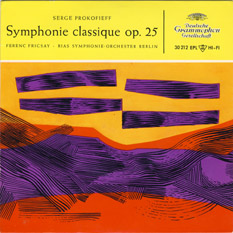
Prokofiev's
"Symphonie Classique". Ference Fricsay and the RIAS
Symphony Orchestra
|
|
Helmut
Zacharias plays Gypsy Airs (Sarasate) and Hejre Kati (Hubay) with
Ferenc Fricsay and the RIAS Sinfonie-Orchester on LPE 17071, coupled
with Borodin's Polovetsian Dances - with the RIAS Chamber Choir
(RIAS Kammerchor).
|
|
|
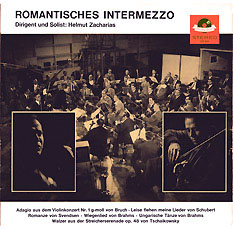
Romantic
Intermezzo: Helmut Zacharias is soloist and conductor of a program
of popular classics. Hungarian Dances 5 and 6 (Brahms), Romance
(Svendsen), Waltz (Tchaikovsky), Salut d'amour (Elgar), Ständchen
(Schubert), Tango (Albeniz), Adagio (Bruch), Schön Rosmarin
(Kreisler), Intermezzo (Mascagni),Souvenir (Drdla), Menuet (Bolzon),
Cradle Song (Brahms).
|
|
Like Winnifred Atwell, who wanted to record Grieg's
Piano Concerto with English Decca, also famous violinist Helmut Zacharias
had a wish to record more serious compositions. He made a recording
of 'Zigeunerweisen' (Gypsy Airs) Op.20 (Pablo de Sarasate) and 'Hejre
Kati' (Jenö Hubay) with the RIAS Symphony conducted by Ferenc
Fricsay, coupled with 'Polovetsian Dances' from Borodin's opera Prince
Igor (LPE 17071). For the Polydor popular label he later recorded
the Adagio of Max Bruch's Violin Concerto as well as the Romance (Romanze)
of Swedish composer Johan Svendsen plus other gems on Polydor 237
335.
All the original releases of the recordings of Ferenc
Fricsay had gatefold covers, except the Variable Micro Grade 78
RPM pressings. Initially the LP covers had the compartments taped
at the edges with blue linen tape. The later releases had the stitched
compartments with plastic lining which then became the trademark of
Deutsche Grammophon Gesellschaft for many years to come.
Lateron these same
recordings were re-released in single covers and the date on the back
of the cover at the end of the fine print tells when a particular
recording was pressed. Generally this is not the date of the actual
recording or the date of the first release.
See the homepage
maintained by Ferenc Fricsay's daughter
Marta Dobay-Fricsay:
Ferenc
Fricsay.
When
in 1956 the orchestra becomes the official orchestra of "Sender
freies Berlin" (SFB), the orchestra's name is changed to Radio
Symphony Orchestra (RSO) Berlin and it keeps up its fine and high
standard of music making, thanks to the devotion of Ferenc Fricsay
who again is appointed as principal conductor in 1959, and thanks
of course to the members of the orchestra. By that time Don Gabor
has already stopped making recordings with the orchestra and also
the recordings with the Düsseldorf Symphony Orchestra and conductor
Otto Matzerath are history. With the advent of the stereo record Don
Gabor discontinues the Remington label altogether and starts to expand
his Masterseal label of which the first productions had already been
released in 1953.
CHOOSE ANOTHER SUBJECT
My thanks
to Mr. Heinrich Köhler, cellist of the RIAS Symphony Orchestra,
for his recollection of the incident with Günter Wandt and for
allowing me to publish several of the signatures he collected in his
scrapbook of conductors who recorded for the Remington label.
Thanks
also to Doris Köhler, the cellist's daughter, for searching her
father's documents after he had passed away. She provided the signature
of Roman Totenberg from February 1st, 1954.
And thanks
to Mrs. Jutta Obrowski who was of great help in bringing me into contact
with Heinrich Köhler.
I thank
Dr. Klaus Holzapfel from Stuttgart, Germany, for providing the technical
data about the Tefifon system and several Tefifon releases, the image
of the label of the Sibelius recording as issued on Varèse
Sarabande, and the image of conductor Jussi Jalas.
Text and research Rudolf A. Bruil - Page created and
first published in August, 2001 and expanded since.
|