

|
 PREVIOUS PAGE
/ This is Page
4 of 5 Pages /
NEXT PAGE
PREVIOUS PAGE
/ This is Page
4 of 5 Pages /
NEXT PAGE
Names and short texts in bold colored font on these pages are links to
separate pages and profiles of artists and other persons.
Names in bold font may appear as a link later in the text.
|
|
 |
 |
|
 |
 |
|
It
is said that Gabor would take any tape he could lay his hands on to release
on his label(s). When beginning building a catalogue such an attitude
would be quite understandable. And since the record business was no big
business at all (unlike today where anybody can start recording and releasing
and can achieve success more easily, thanks to the more accessible digital
recording equipment), any item that would enlarge the catalogue was welcome.
It seems that Don Gabor knew quite well that the releases with Albert
Spalding, The canisters with the tapes were labeled and packed in Vienna (and later also in Berlin) and were shipped to the United States for mastering. Many times the handwriting on the list or the canister's label was not very clear. That is why the recording of Schubert's Trout-Quintet by Günther Breitenbach, Nikolaus Hubner (spelled Nicholaus), Johannes Krump, Walter Panhoffer (spelled Panhofer) and Willy Boskovsky, together "The Boskovsky Quintette" was named BOSHOVSKY QUINTETTE, the 'Austrian' k being read as h. There were more of those mistakes. Don
Gabor wanted to create a diverse catalogue like the big labels did. He
did not restrict himself to violinists and pianists but also the field
of song and opera was present in the names of Rosette Anday, Kurt Baum,
Karin Branzell, Giacomo Lauri-Volpi, As
the market developed and competition increased, a new look was necessary
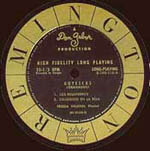
to regain attention and the label was redesigned. The new (third) label
had the letters of the name REMINGTON placed in boxes in a circle. The
colors of the label were black and gold (and later sometimes silver).
Eventually the new distinctive logo was placed as a vertical bar at the
left next to the spine of each cover, a logo that could not be overlooked
and certainly helped to promote the label. This new identity was designed
by Alex Steinweiss who as a free lancer worked for Columbia Records at
the same time.
Not only fresh releases had this new style. Covers of existing recordings were redesigned and got the new circular label. But when technical progress in the field of matrix production and recording technique was made and the playback systems were improved, the releases more and more showed their less eminent quality. When
conductor |
 |
 |
 |
|
 |
 |
|
The
new sound boasted of multiple microphone placement and the improved sound
of the productions was given the name "MUSIRAMA" and the label showed
the image of atoms as they were visualized in those days. Well
chosen and abbreviated quotations from reviewers also
adorned the back covers Furthermore an educational series entitled 'Music
Plus! was conceived with Sigmund Spaeth. And to add even more to the importance
of the label Gabor and Halasz devised with Theodore and Alice Pashkus
an inspirational series for young violin students and amateurs: |
 |
|
 |
|
 |
|
|
What
the quality of the early Austrian sound recordings originally must have
been can be heard on reissues of original tapes in simulated stereo on
the Austrian label Vibraton of performances by One
should never forget that many recordings in the catalog date from 1950
or 1951, a mere three years after the introduction of the LP by Columbia,
and that the MUSIRAMA recordings were done as early as 1953. |
|
|
 |
 |
|
 |
 |
|
The
USA is a big territory and the company's turnover must have increased
significantly. New offices were rented on 500 Fifth Avenue. And now the
Remington recordings were also exported to several
European countries: Belgium and The Netherlands, even after
the Remington label was no longer listed in the Schwann and Long Player,
they were available in the USA and Europe well after 1957. In
France Remington recordings were released on the In
France recordings were made with |
 |
 |
 |
|
 |
Concerteum
in France released Remington recordings. At left Ossy Renardy with Paganini
Caprices and Hans Wolf conducting Mozart.
|
|
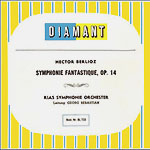
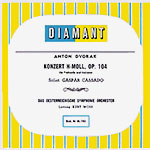
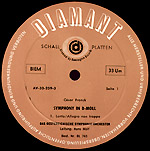
The collaboration with Bertelsmann in Germany (starting in 1953) resulted in many MUSIRAMA-recordings made with the RIAS Symphony Orchestra. In Germany they were of course released on Bertelsmann's Phonoring. But Don Gabor wanted to release the older recordings made in Austria in Germany too. I suspect that he created his own German label named DIAMANT. The records were pressed from Remington matrixes, maybe in Germany. It is not sure if the covers were manufactured in Germany. They could have been made in the Webster plant as they were manufactured the American style. On the label was printed "Licensed by Remington Records." The Diamant covers had a standard layout. On the front the composer, the works and the names of the performers were printed as well as a reference number for ordering the item, in German "Best. Nr." (Bestell Nummer). The back was plain, there were no liner notes. On
the Diamant label appeared Franck's Symphony in D conducted by Hans
Wolf (BL 743), Astrid Varnay singing Wagner arias (BL 737)
and On BL 739, Jorge Bolet and Thor Johnson performed Prokofiev's Piano Concerto Op. 16. The cover mistakingly mentioned that Johnson conducted the Austrian Symphony Orchestra instead of the Cincinnati Symphony. Violinist Michèle Auclair in Tchaikovsky (BL738), Fritz Busch with Beethoven's Eroica (BL 741). Symphony Fantastique (Berlioz) with Georges Sebastian in the new Musirama sound (in the USA the label with the atomic symbol) was released as BL 733 while this same recording was also released by Bertelsmann. The Diamant release was of course against the terms in the contract. Cellist Heinrich Köhler told me that there was a law suit, but he did not remember the actual cause. The releases recorded in Germany and offered in Germany on the Diamant label could have been the cause and the agreement was ended. |
 |
 |
In
Australia Remington recordings were released on the Festival label.
|
|
Wherever
Laszlo Halasz went to fulfill his engagements to conduct, be it in Germany,
Spain, Italy or France, recordings for the Remington MUSIRAMA label were
made. In Berlin with the RIAS Symphony and pianists Laszlo Halasz also seized opportunities to make recordings with other orchestras and ensembles. Recordings were later also made with the Düsseldorf Symphony Orchestra. And a complete Cosi Fan Tutte was recorded with singers Erna Hassler (soprano), Hetty Plümacher (contralto), Käthe Nentwig (soprano), Albert Weikenmeier (tenor) , Karl Hoppe (baritone) and Joseph Dunnwald conducting the Stuttgart Tonstudio Orchestra: R-199-117/3. Highlights from this recording were released on R-199-162. |
 |
Several
Remingtons were released in Germany on the Diamant label: Symphony Fantastique
(Berlioz), Cello Concerto (Dvorak), Symphony (Franck).
|
 |
|
 |
 |
|
In
Germany Gabor launched the Diamant label for the release of recordings
made in Austria: Franck Symphonie (Hans Wolf), Famous Opera Arias (Astrid
Varnay), Dvorak Cello Concerto (Gaspar Cassado). An oddity is the Diamant
release of Prokofiev's Piano Concerto Bo. 2 with Jorge Bolet. But the
Diamant issue states that Thor Johnson conducts the Austrian Symphony
Orchestra instead of that of Cincinnati. Before
there was trouble, excerpts of Remington recordings were released on
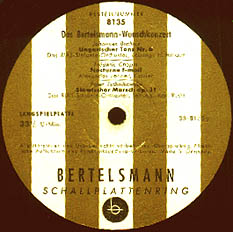
a Bertelsmann 10" disc called "Wunschkonzert - Meisterwerke
der Klassik" (Classical Masterworks). This shows that Bertelsmann
also had access to earlier Remington recordings made in Austria as Alexander
Jenner plays here one movement of Beethoven's Moonlight Sonata taken
from Remington R-199-10. Could be that The
first cellist of the
Of course, Laszlo Halasz had to see to it that the limited budget and the recording time were well spent and thus did not give Günther Wand (at age 42) the time to shape the performance and bring it to a higher level. If it were not for the limited time, we would have had another historic performance of Günther Wand, but this time with the RIAS Symphony Orchestra on the Remington label. Most
conductors however were glad to have a job though. They accepted the
limited time schedules. Some of the conductors were hardly known like
Karl Rucht. Relatively unknown at the time were Wolfgang Sawallisch,
Jonel Perlea ,
Manuel Rosenthal,
George
Sebastian ,
Georg
Ludwig Jochum (brother of famous Eugen Jochum). Fact is that also in this case Don Gabor did not buy ready tapes, and in no case tapes of obscure and illegal origin, (as Eli Oberstein did for his Royale label), and Gabor did not invent names, but hired a genuine and well trained orchestra of professional musicians and through Laszlo Halasz very able conductors and soloists were contracted. Yet a three hour session was too short for a recording of Brahms's 2nd Concerto with Kilenyi and Perlea which did not show some minute imperfections. Generally the performances were of a very good quality which rose far above the standard of any provincial orchestra and certainly above the quality of the 'Austrian Symphony Orchestra' or 'Niedersterosterreichisches Tonkünstler Orchester' which was also founded in 1946 but did not get the time to rehearse enough before recording. |
|
On
Bertelsmann Schallplattenring 8135 a variety of Remington artists can
be heard:
|
 |
Wolfgang
Sawallisch, Alexander Jenner, Karl Rucht and Laszlo Halasz.
|
|
|
The
gold/white striped label of Bertelsmann Schallplattenring 8135..
|
 |
|
In
Paris, where Laszlo Halasz had engagements also and was to perform with
pianist Samson François, George Enescu's Dixtuor was recorded with
the composer conducting the French National Orchestra. On
most covers the annotation "Recorded in Europe" was printed. In those
days many American companies traveled with their tape recorder practically
all over Europe, from Denmark to Austria and from Berlin to Rome. At home
in the US there were many restrictions imposed by the Petrillo act, restrictions
concerning working hours of artists and orchestras and the fees which
made the productions very costly. If one did not have the facilities to
tape in Europe, existing tapes from radio broadcasts and even old tapes
from the "Reichs Rundfunk Gesellschaft" which were made during World War
2, could be bought. In
those days there was a lively trade in taped performances of all sorts
of works and it happened that inferior labels acquired the same tapes
of performances which were released on mayor labels or simply copied a
recording of a quality label and then printed fancy names for singers,
instrumentalists and conductors on labels and covers and often omitted
a movement from a symphony or abbreviated the work by splicing in order
to avoid that the bootleg was recognized or just because they did not
have any knowledge of the composition. Cover and label of Frieda Valenzi's recording of "Variations Symphoniques" of César Franck, state the name of the conductor as Jean Moreau. A conductor with that name is not known. Apparently Jean Moreau was Jean Morel, originally from France, who worked also in the USA and made several recordings with DECCA/LONDON and American Columbia. Jean Morel was also a conductor at the New York City Opera Company. When I asked Mrs. Valenzi about the conductor she could not remember facts about Jean Moreau. The handwriting on the container with the recorded tape must have been wrongly read and copied. The
soloist in Glazunov's Violin concerto on R-199-191 is André
Gabriel. No data can be found about this artist. Was he an upcoming
star who never made it? Was he the principal violinist of the RIAS Symphony
Orchestra? Was the artist Tossy Spivakovsky? In the 1953 edition
of the Remington record catalog Don Gabor announced the new Musirama recording
releases. New recordings with various artists were in the making. One
of these artists is violinist Tossy Spivakovsky. But his name never
appeared on the Remington label. I own a couple of old Heliodor records
recorded in Poland. One with violinist Wanda Wilkomirska. And there is
also the Beethoven Concerto with Roman Totenberg. That means that he was
traveling and performing in Europe. Known is that he performed in the
early 1950s in Amsterdam in the Concertgebouw. So there was reason to
suspect that André Gabriel was Roman Totenberg. Allan Evans of
Arbiter Records, who interviewed Roman Totenberg extensively and prepared
the 2 CD set "The Art of Roman Totenberg from Bach to Webern",
confirmed that the soloist in the Remington recording is indeed Roman
Totenberg. See the description on the page about the Record
R-199-76 mentions There
is a recording by The Boshovsky Sextet. This is certainly Willy
Boskovsky's Sextet. The 'k' in the handwriting on the container
of the tape must have been interpreted as 'h'. |

|
 |
||
 |
Frieda
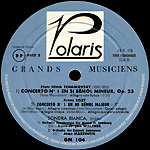
Valenzi's Merit release, Sondra Bianca performing Liszt on Plymouth and
on Volaris, and at right Conductor X with Symphony No. 1 by Beethoven
|
 |
 |
Carlos
Montoya on R-199-171 and R-199-179, the Palace reissue of 171 and Lydia
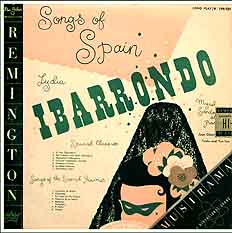
Ibarrondo on R-199-139.
|
 |
|
 |
 |
|
The covers of R-199-171 and R-199-179 (reissued on Vox Records STPL 513 430) of guitarist Carlos Montoya state "Recorded in Spain". Could be that the recordings were made when Laszlo Halasz was on tour and conducting in Barcelona, and could be that Montoya who lived in the US was vacationing in Spain at the time. One is not always sure if "Recorded in Europe" or in this case "Recorded in Spain" is in all cases correct. The recordings could have been ready tapes or new recordings. In any case the annotation "Recorded in Europe" was often an easy way to avoid questions by the officials of the union. I do not have a copy of the other record of Carlos Montoya (R-199-134) accompanying mezzo-soprano Lydia Ibarrondo. This album most likely was recorded in the USA. In any case Ibarrondo's "Songs of Spain" (R-199-139) was recorded in the USA as she lived there. On the latter the mezzo-soprano was accompanied by Miguel Sandoval (piano), and Juan Oñatibia (txistu and tun-tun, on side 2). The selections are El vito,Del cabelo ma´s sutil, Molondron, Cancion Castellana, Cantares, La maja dolorosa. Granadina, Caminito de Avilés, Charrada, En casa del Tio Vicente, Pastores de la Sierra, Burlesca, Nostalgia, El pano, Vescos. Cover
and label of |
TOP OF PAGE / NEXT PAGECopyright 1995-2008 by Rudolf A. Bruil
